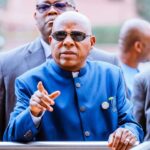

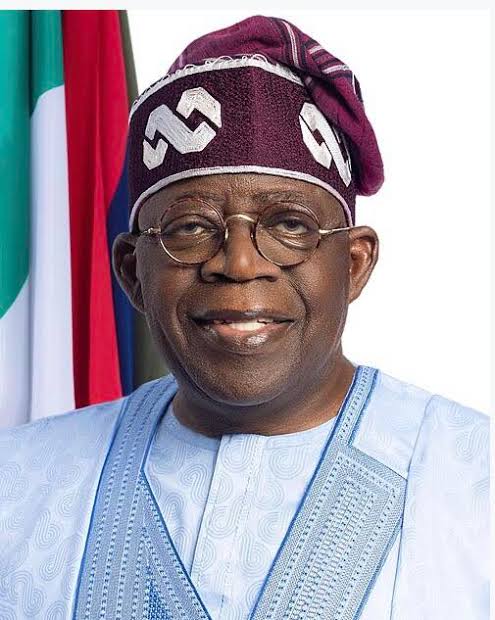
A chieftain of the All Progressives Congress, Biodun Ajiboye, has said President Bola Ahmed Tinubu did not personally remove the fuel subsidy but merely announced its removal, arguing that the subsidy regime had already become unsustainable before the administration took office.
Ajiboye made the statement during an interview on Politics Today, a Channels Television programme, where he defended the president’s handling of the fuel subsidy issue following his inauguration in May 2023.
According to Ajiboye, there was no practical or financial possibility of continuing with fuel subsidies at the time President Tinubu assumed office.
He said the economic realities inherited by the administration meant that subsidy payments could no longer be sustained, regardless of who emerged as president.
Ajiboye maintained that the subsidy system had effectively collapsed before Tinubu’s announcement and that the president simply communicated an unavoidable reality to Nigerians.
“Right as we speak today, in May 2023, whether we like it or not, there was no possibility of continuing with subsidy,” Ajiboye said during the interview.
He argued that the popular narrative suggesting that Tinubu abruptly removed fuel subsidy without adequate preparation does not accurately reflect the situation on ground at the time.
According to him, the subsidy had become financially impossible due to the state of government revenues and mounting fiscal pressures.
Ajiboye insisted that President Tinubu did not take an active decision to end the subsidy but rather acknowledged that it was no longer in operation.
“Tinubu did not remove it; he only announced the removal,” he said.
He questioned claims that the president should have prepared for subsidy removal, asking how such preparation could have been possible when the policy itself was no longer viable.
Ajiboye said the federal government was already unable to meet subsidy obligations before the change in administration.
He explained that oil revenues were insufficient to sustain the subsidy regime, especially with rising global energy prices and declining domestic production.
According to him, continuing subsidy payments would have worsened the country’s fiscal crisis and further weakened the economy.
The APC chieftain also defended the broader economic policies of the Tinubu administration, saying they are aimed at correcting long-standing structural problems.
He said the government is focused on reversing negative economic trends inherited from previous administrations.
Ajiboye claimed that the administration has recorded notable improvements in key economic indicators since taking office.
One of the areas he highlighted was employment, where he said the country has experienced significant progress.
According to Ajiboye, unemployment has dropped sharply from about 33 percent to roughly 4 percent.
He attributed the improvement to growth in sectors outside oil, suggesting that government reforms have helped stimulate economic activity.
He said increased investment in areas such as agriculture, services, and small-scale enterprises has contributed to job creation.
Ajiboye argued that while Nigerians are feeling the short-term impact of economic reforms, the long-term benefits will become clearer over time.
He said difficult decisions were inevitable given the state of the economy inherited by the administration.
According to him, postponing such decisions would only have deepened the country’s economic challenges.
He urged Nigerians to be patient with the government as reforms take root.
Ajiboye also criticized what he described as misinformation surrounding the fuel subsidy debate.
He said political opponents have used the issue to score points without acknowledging the underlying financial realities.
According to him, the administration has been unfairly blamed for a problem that had already reached a breaking point.
The fuel subsidy announcement made by President Tinubu during his inauguration speech in May 2023 triggered widespread debate and public reaction.
Fuel prices rose sharply across the country following the announcement, leading to increased transportation and living costs.
The development sparked protests and criticism from labour unions, civil society groups, and opposition parties.
The government has since introduced various intervention measures aimed at cushioning the impact of higher fuel prices.
These include palliative programmes and initiatives targeted at vulnerable groups and small businesses.
Ajiboye said such measures demonstrate that the administration is conscious of the hardships faced by Nigerians.
He maintained that the government remains committed to stabilising the economy and improving living standards.
According to him, reforms currently underway are necessary steps toward building a more resilient and sustainable economy.
He said the fuel subsidy regime, as it existed, benefited only a small segment of the population and encouraged inefficiency and corruption.
Ajiboye added that redirecting funds previously spent on subsidies would allow greater investment in infrastructure, education, and healthcare.
He concluded that President Tinubu’s announcement was not an act of policy recklessness but an acknowledgment of economic reality.
According to him, history will judge the decision as a necessary step toward long-term economic recovery and growth.