

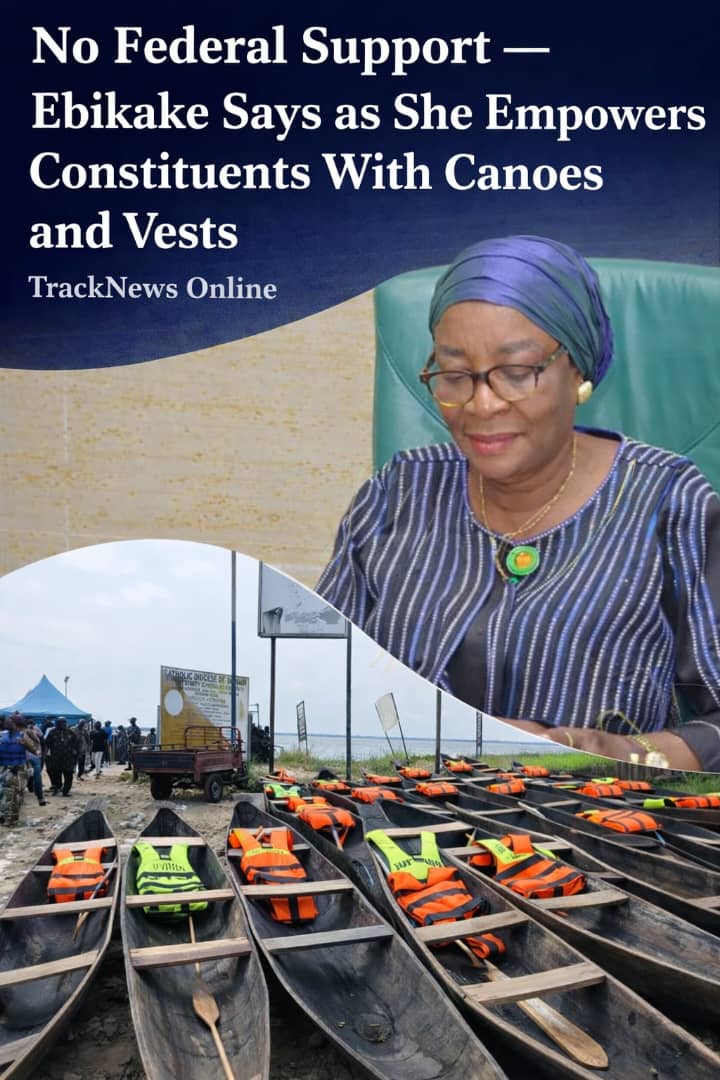
The member representing Brass/Nembe Federal Constituency in the House of Representatives, Hon. Maria Ebikake, has declared that she has not received any supportive funds from the federal government for constituency projects. She made the statement while distributing canoes and life vests to residents as part of an empowerment initiative.
Ebikake addressed constituents during the distribution event, stating that the items were procured through her personal efforts. According to her, no federal allocation had been made available to her office to support such interventions.
She told the gathering that she decided to move ahead with the empowerment program despite the lack of government backing. The lawmaker urged beneficiaries to appreciate what she described as her personal sacrifice.
“I am doing this with my own, so whatever little thing I am doing, please appreciate me,” she said while speaking to community members. Her remarks immediately drew attention, particularly in the context of ongoing debates about constituency funding and legislative responsibilities.
The empowerment program involved the distribution of canoes and life vests to residents of riverine communities in Brass and Nembe. The area, located in Bayelsa State, relies heavily on water transportation for daily activities, including fishing, trade, and commuting.
Community members present at the event expressed gratitude for the items, noting that transportation across waterways remains a major challenge. Some beneficiaries said the canoes and safety equipment would help improve mobility and reduce risks associated with river travel.
However, Ebikake’s claim of receiving no federal support has sparked political conversations within the constituency and beyond. Constituency projects are typically funded through federal budgetary allocations facilitated by lawmakers.
Her statement raises questions about the disbursement and management of such funds. It also adds to ongoing national discussions about transparency and accountability in the implementation of constituency projects.
Political observers say the lawmaker’s comments could be interpreted in different ways. Some view it as a criticism of the federal system and a suggestion that lawmakers may not always receive adequate backing to meet their campaign promises.
Others argue that constituency project funds are embedded within federal ministry budgets and not directly handed to legislators. According to this perspective, lawmakers are expected to nominate projects while execution is carried out by relevant government agencies.
Ebikake did not provide detailed clarification on whether she meant that no funds had been released at all or whether bureaucratic processes had delayed implementation. Her remarks nonetheless resonated strongly with those present at the event.
Opposition voices within the state have reportedly questioned the statement, asking for further explanation regarding the status of constituency allocations. Some critics have called for greater transparency to clarify whether funds were budgeted but not accessed.
Supporters of the lawmaker, however, defended her position. They described her actions as a demonstration of commitment to grassroots development despite financial constraints.
The distribution event itself drew significant turnout from local leaders and residents. Traditional rulers and youth representatives were said to be in attendance as the items were handed over to beneficiaries.
Brass and Nembe are predominantly riverine areas where water transportation is central to economic and social life. Accidents involving overloaded boats and lack of safety equipment have been recurring concerns in the region.
The provision of life vests in particular was welcomed by community members who cited safety challenges. Some residents noted that government interventions in such areas have often been insufficient.
Ebikake’s remarks may intensify scrutiny on how federal constituency projects are structured and funded. They also highlight the broader political tension between elected representatives and the executive arm over resource allocation.
As reactions continue to emerge, the lawmaker’s claim is likely to remain part of the public discourse. Whether it leads to official clarification from relevant authorities remains to be seen.
For now, the empowerment initiative has placed a spotlight on both local development needs and the complex politics surrounding federal funding.