

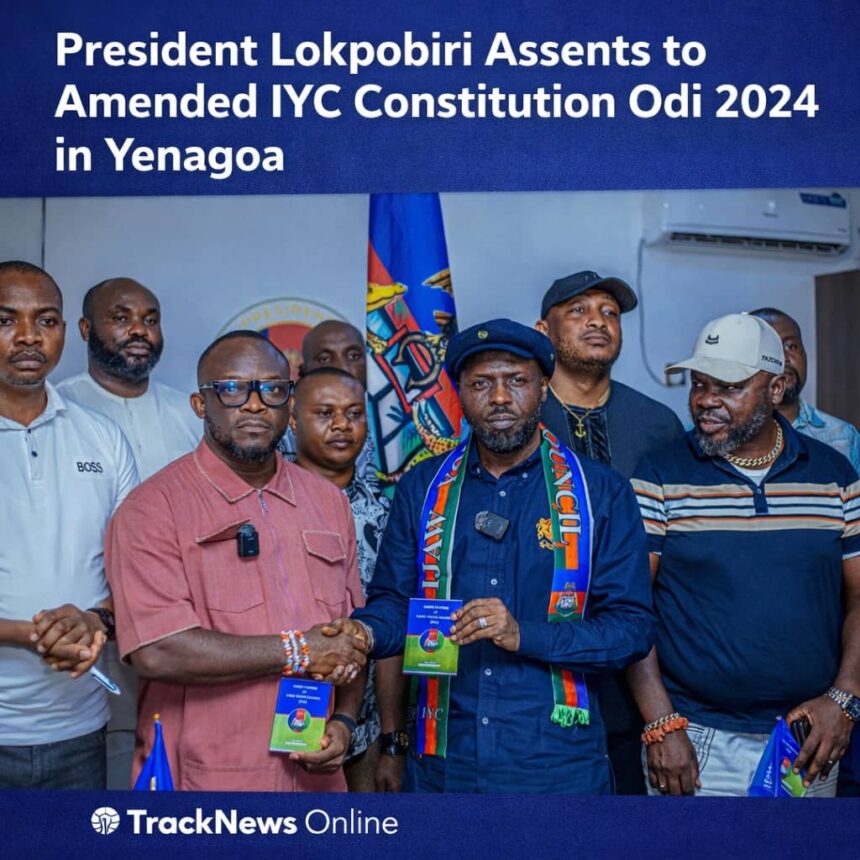
The Ijaw Youth Council (IYC) Worldwide has formally entered a new phase of governance following the assent to the amended IYC Constitution Odi 2024 by its President, Sir Jonathan Lokpobiri Snr. The signing took place on February 16, 2026, at Ijaw House in Yenagoa, Bayelsa State.
The development marks the official transition of the council into what its leadership described as a strengthened era of structural discipline and democratic transparency. The assent followed an expanded meeting of the National Executive Council (NEC).
With the president’s signature, the amended constitution now becomes the supreme legal framework guiding the activities of the IYC. The document is binding on millions of Ijaw youths across the Niger Delta and in the diaspora.
The constitutional review process began with deliberations at the National Convention held in Odi in December 2024. Further discussions and resolutions were reached during another National Convention in Yenagoa on August 23, 2025.
During those conventions, stakeholders examined contentious provisions and addressed identified gray areas within the existing framework. The amendments were designed to strengthen internal democracy and improve administrative efficiency.
The assent ceremony, though brief, was attended by key organs of the council’s leadership. Among those present was the Speaker of the IYC Mobile Parliament, Rt. Hon. Gabriel Allen.
Members of the 9th National Executive Council were also in attendance. Zonal and chapter chairmen and secretaries, along with other critical stakeholders of the council, witnessed the event.
One of the major changes introduced in the amended constitution is the abolition of the Option A4 voting system. The council has officially adopted the Open Secret Ballot System for its elections.
The new voting system is intended to enhance voter privacy, security, and fairness during internal electoral processes. Leadership stated that the reform aligns the council’s electoral procedures with global democratic standards.
Another significant amendment involves the adjustment of age brackets for leadership positions. The constitution now caps eligibility for elective offices at 45 years.
For ad-hoc committee appointments, the age limit has been set at 50 years. The change is aimed at ensuring that the council remains youth-driven while maintaining experienced participation in committee assignments.
The amended constitution also introduces the Office of Persons Living with Disabilities (PLWD) Representative within zonal leadership structures. This provision formally guarantees representation for persons with disabilities in the council’s governance framework.
Council officials described the inclusion as a step toward inclusivity and equal participation. It is expected to provide a platform for addressing issues affecting members living with disabilities.
In addition, the constitution recognizes the IYC United Kingdom Chapter as an integral part of the council’s global structure. The UK chapter has been granted six permanent delegate slots in national elections.
The recognition underscores the growing influence of the Ijaw diaspora in council affairs. It also reflects efforts to strengthen international participation in decision-making processes.
Speaking during the ceremony, Sir Jonathan Lokpobiri Snr said the constitution represents more than a regulatory document. He described it as a covenant that defines the council’s direction and values.
According to him, the amendments will streamline rules of engagement within the organization. He added that the reforms position the IYC as a model for youth-led ethnic governance.
Lokpobiri stated that by embracing diaspora participation and formal inclusion of persons with disabilities, the council has secured a stronger foundation for future leadership. He emphasized that transparency and empowerment remain central to the new framework.
He further noted that the constitution provides a clear compass for the council’s activities moving forward. The president said the document would guide the Ijaw youth struggle and institutional development.
With the assent concluded, the amended constitution is now fully operational. The council enters the 2026 calendar year under the new legal framework.
Leadership expressed confidence that the reforms will promote unity and accountability within the organization. The IYC now moves forward with what officials described as a unified mandate anchored on transparency and youth empowerment.