
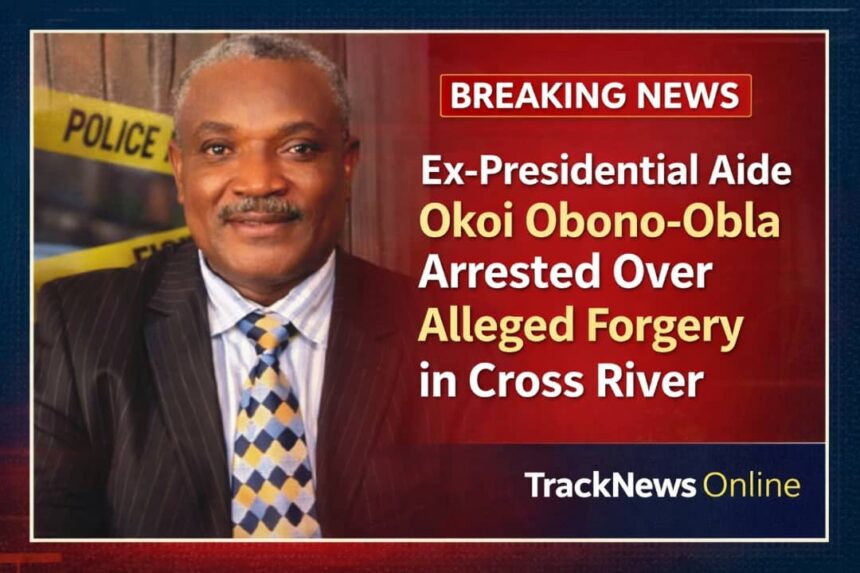
The Cross River State Police Command has arrested former presidential aide and lawyer, Okoi Obono-Obla, over allegations of forgery and unlawfully gaining entry into the legal profession through false claims. The arrest was carried out on Thursday, February 19, 2026, in Ugep, Yakurr Local Government Area of the state.
Police authorities said Obono-Obla was apprehended at about noon at Abuja Park in Ugep. The arrest followed a petition submitted to the Commissioner of Police in Cross River State.
According to the Police Public Relations Officer, ASP Eitokpah Sunday, the petition accused the former presidential aide of offences related to forgery. It also alleged that he obtained professional qualification and admission into the legal field under false pretence.
The police spokesperson stated that officers acted in line with due process. He explained that the Nigeria Police Force has the constitutional mandate to investigate criminal complaints brought before it.
Following his arrest, Obono-Obla was taken into custody and subsequently transferred to the State Criminal Investigation Department in Calabar. Authorities confirmed that further investigations are currently ongoing at the facility.
The police addressed reports circulating on social media shortly after the arrest. Some of the reports had claimed that Obono-Obla was kidnapped in Ugep by unidentified individuals.
The command firmly denied those claims. It stated that the former presidential aide was not abducted and that no unknown gunmen or unauthorized security groups were involved in the incident.
According to the police, the arrest was lawful and carried out by duly authorized officers. They emphasized that the operation was based strictly on the petition received and the need to investigate the allegations raised.
The command also clarified that Obono-Obla’s legal representative has been informed about the development. His lawyer is said to be aware of the situation and involved in the matter.
In addition, family members of the former aide have reportedly been notified of his whereabouts. The police maintained that there was no secrecy surrounding his detention.
Authorities used the opportunity to caution members of the public against spreading unverified information. They warned that false reports, particularly those suggesting kidnapping, could create unnecessary panic and disrupt public peace.
The police reiterated their commitment to transparency in handling the case. They assured the public that the investigation would be conducted professionally and in accordance with the law.
Obono-Obla previously served as a presidential aide and has been a known figure in Nigeria’s political and legal circles. The latest development places him at the center of serious allegations concerning his professional credentials.
While details of the petition have not been fully disclosed, the police confirmed that it raises questions about the authenticity of documents linked to his legal qualification. Investigators are expected to examine relevant records and documentation as part of the inquiry.
The command stated that more information would be made available as the investigation progresses. It did not indicate whether formal charges have been filed at this stage.
The case has drawn attention both within Cross River State and beyond, given Obono-Obla’s previous public role. However, police authorities stressed that the matter remains under investigation and urged the public to allow due process to take its course.
They reaffirmed that every individual is entitled to a fair investigation under Nigerian law. The police also emphasized that their actions were guided solely by the contents of the petition and the need to determine the facts.
As of the time of reporting, Obono-Obla remains in custody at the State Criminal Investigation Department in Calabar. Further updates are expected once preliminary findings are concluded or formal legal steps are initiated.
The Cross River State Police Command concluded by reiterating its appeal for calm. It urged residents to rely on official statements and avoid sharing unconfirmed narratives that could mislead the public.