

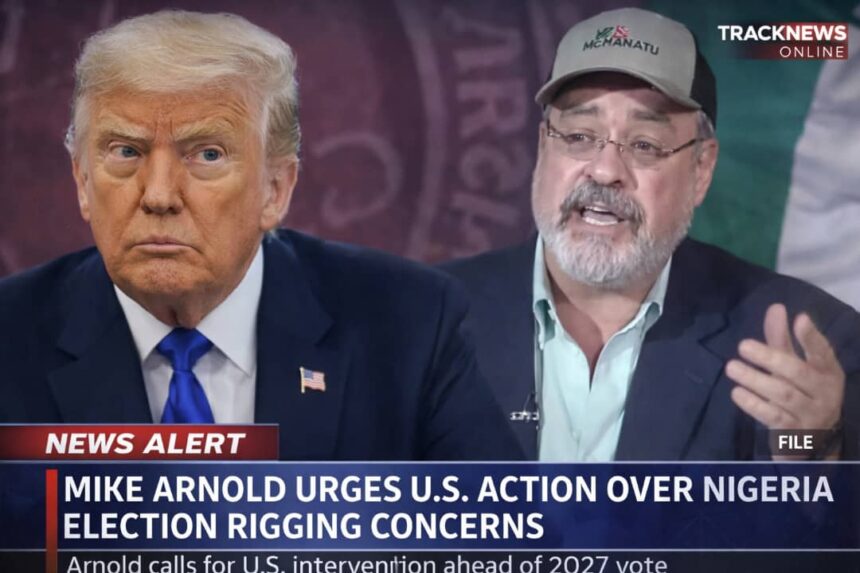
Political commentator Mike Arnold has called for the United States to take action over Nigeria’s electoral process, alleging that elections in the West African nation have been manipulated for decades. In a strongly worded statement, Arnold warned that without international intervention, the 2027 general elections could face similar challenges under the ruling All Progressives Congress (APC) led by President Bola Tinubu.
Arnold’s remarks come amid ongoing debates about electoral transparency and democratic reforms in Nigeria. He argued that the integrity of future elections is critical not only for Nigeria but also for regional stability and global democratic standards.
In his statement, Arnold claimed that Nigeria’s elections “have been rigged for decades” and suggested that the pattern could continue in 2027 if external pressure is not applied. He specifically referenced the Tinubu-led APC government as a key political actor ahead of the next election cycle.
Arnold framed the issue as one of international importance, urging the United States to pay closer attention to Nigeria’s democratic process. He maintained that American engagement could play a role in ensuring credible and transparent elections in Africa’s most populous country.
Nigeria, with an estimated population of more than 220 million people, is the largest nation in Africa by population and one of its largest economies. The country has held successive democratic elections since the end of military rule in 1999, though several of those elections have been accompanied by allegations of irregularities and disputes.
Arnold emphasized Nigeria’s demographic profile in his appeal. He noted that approximately 60 percent of Nigerians are under the age of 25, describing the country as a youthful nation with significant untapped potential.
He also pointed to Nigeria’s entrepreneurial landscape, describing it as having one of the highest rates of entrepreneurship in Africa. According to Arnold, this dynamic youth population represents a major opportunity for economic transformation if supported by credible democratic institutions.
In addition, Arnold highlighted the financial contributions of Nigeria’s diaspora community. He said Nigerians living abroad send an estimated $20 billion back home each year, underscoring the country’s global economic ties and the importance of stable governance.
Arnold further referenced Nigeria’s growing technology sector, which has attracted international investors in recent years. The country’s tech ecosystem, particularly in cities like Lagos, has produced several high-profile startups and has been described by analysts as one of the most vibrant in the developing world.
According to Arnold, a credible and transparent election in 2027 could significantly alter Nigeria’s political and economic trajectory. He argued that free elections would enable citizens to choose leadership that reflects their aspirations and unlocks the country’s potential.
Conversely, he warned that disputed or flawed elections could deepen existing challenges. Arnold stated that continued allegations of election manipulation could contribute to political instability, corruption, and violence.
Nigeria has faced security and governance challenges in recent years, including insurgency in parts of the country, economic pressures, and public dissatisfaction over living costs. Elections in the country have sometimes been accompanied by legal battles, with opposition parties challenging results in court.
The Independent National Electoral Commission (INEC), Nigeria’s electoral body, has repeatedly pledged to improve the credibility of the electoral process through technological innovations and reforms. The commission introduced electronic transmission of results and biometric voter accreditation in recent election cycles as part of those efforts.
Arnold did not outline specific policy steps he believes the United States should take but stressed that international attention could influence electoral standards. His comments add to broader conversations among activists and observers who have called for stronger oversight and accountability mechanisms in Nigeria’s political system.
As Nigeria moves closer to the 2027 elections, discussions around electoral integrity are expected to intensify. Political parties, civil society organizations, and international partners are likely to play key roles in shaping the environment in which the next vote takes place.
Arnold’s statement reflects growing scrutiny of democratic institutions in Africa’s largest democracy. Whether his call for U.S. action will gain traction remains to be seen, but his remarks have drawn attention to the stakes surrounding Nigeria’s next national election.