
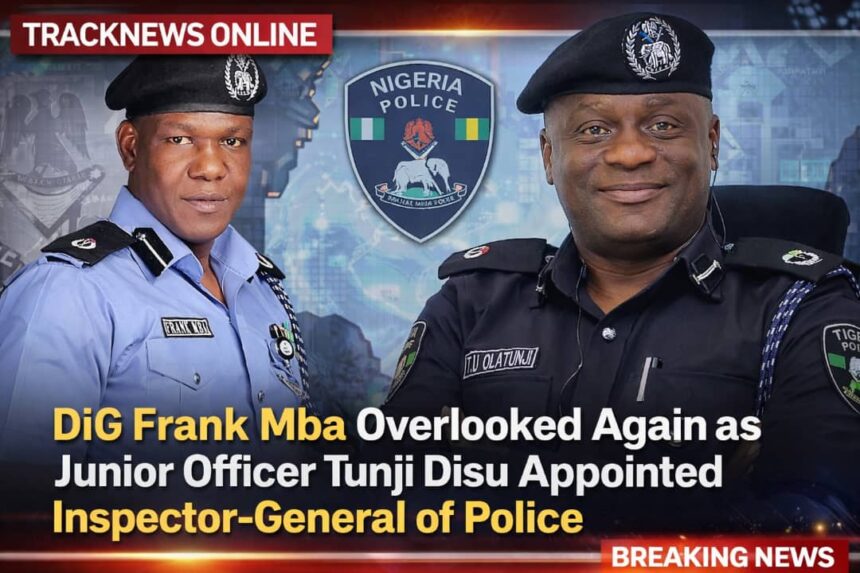
Deputy Inspector-General of Police Frank Mba has again been bypassed in the appointment of a new Inspector-General of Police, despite being the most senior serving officer in the Nigeria Police Force at the time of the latest transition.
Assistant Inspector-General Tunji Disu was elevated to the top position, a development that has drawn attention within security and political circles because of Mba’s seniority and eligibility.
Mba’s exclusion marks the second consecutive instance under the current administration in which he has been passed over for the role. In 2023, he was similarly overlooked when former Inspector-General Kayode Egbetokun was appointed.
At the time of that appointment, Mba was among the highest-ranking Deputy Inspectors-General and had more years remaining in service than Egbetokun. Both Egbetokun and Disu are from the South-West region.
Force records indicate that Mba was the top-ranking eligible officer in the hierarchy during both leadership transitions. His continued exclusion has renewed debate about seniority, regional representation and adherence to established conventions within the police force.
The Nigeria Police Force traditionally follows a pattern in which the Inspector-General is appointed from among serving Deputy Inspectors-General, often reflecting seniority in rank and years of service. However, the appointment of Disu, who was junior in rank to Mba, has been viewed by some retired officers as a departure from that convention.
Security sources and some lawmakers have pointed to the 2023 extension of Egbetokun’s tenure as a key factor that altered the succession timeline. According to them, the extension shifted the leadership window in a way that reduced Mba’s chances of ascending to the position before reaching retirement.
The 2026 appointment has followed a similar trajectory. With Disu’s elevation, leadership of the force remains within the same regional bloc, prompting renewed concerns about federal character principles.
The South-East region, from which Mba hails, is now without representation at the top of the Nigeria Police Force. Observers note that despite producing the most senior eligible officer during both transitions, the region has not secured the Inspector-General position.
Critics argue that this pattern raises questions about equity and inclusiveness in federal appointments. They contend that adherence to federal character principles is intended to promote national balance in key public offices.
There has been no detailed official explanation outlining the criteria that guided the latest appointment. The absence of a formal clarification has fueled speculation that considerations beyond seniority influenced the decision.
Supporters of the administration, however, maintain that the President retains constitutional authority to appoint the Inspector-General of Police. The position is not automatically determined by seniority alone, and broader strategic, operational and policy considerations may be taken into account.
Mba, a former Force Public Relations Officer, has held several strategic positions within the Nigeria Police Force. His career spans decades of service, and he has been regarded as one of the most visible and experienced officers in the institution.
The development has sparked discussion within security circles about morale and institutional stability. Some retired senior officers say predictable succession patterns can strengthen confidence within the ranks, while abrupt deviations may generate uncertainty.
Lawmakers monitoring the situation have also emphasized the importance of transparency in high-level security appointments. They argue that clear communication of criteria can reduce perceptions of political or ethnic bias.
As of now, no formal protest or legal challenge has been announced regarding the appointment. Mba has not publicly commented on the decision.
The latest leadership change underscores ongoing debates about governance, representation and institutional tradition within Nigeria’s security architecture. Attention is likely to remain on how the new Inspector-General consolidates leadership and addresses concerns raised in the aftermath of the appointment.