

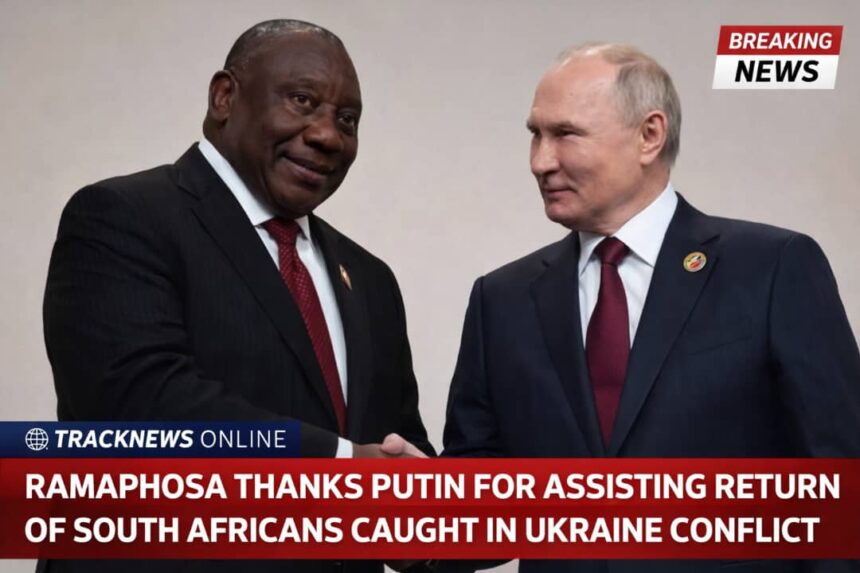
President Cyril Ramaphosa has expressed appreciation to Russian President Vladimir Putin for facilitating the return of 17 South African men who were allegedly misled into traveling to Russia for what they believed was security training but later found themselves involved in frontline combat in Ukraine.
According to South African officials, four of the men have already returned home. Eleven others are expected back in the coming days, while two remain in Russia. One of the remaining individuals is hospitalized in Moscow, and another is still undergoing travel processing procedures.
The group reportedly traveled to Russia after being promised employment described as “bodyguard training.” However, authorities say the men later discovered they had been deployed to active combat zones in Ukraine, specifically in the Donbas region.
Distress calls were sent in November after the group became trapped amid intense fighting. Family members subsequently alerted South African authorities, prompting diplomatic engagement to secure their release and repatriation.
Government officials confirmed that diplomatic channels were activated following the reports. Ramaphosa acknowledged Russia’s cooperation in facilitating the return process.
The South African government has not indicated whether the men were formally enlisted in Russian military units or affiliated with private military structures. However, authorities have emphasized that investigations are underway into suspected human trafficking, fraud and illegal recruitment for foreign military service.
Officials say the probe will examine how the men were recruited, who organized the travel arrangements and whether any domestic or international networks were involved.
South Africa’s legal framework places restrictions on citizens participating in foreign armed conflicts without proper authorization. Authorities have previously warned against involvement in overseas combat operations.
The incident has drawn attention to reports of foreign nationals being recruited under misleading pretenses for roles linked to the ongoing war in Ukraine. International observers have raised concerns about exploitative recruitment practices targeting individuals seeking employment opportunities abroad.
The Ukrainian conflict, which began in 2022, continues to draw global diplomatic and humanitarian attention. While South Africa has maintained a non-aligned stance in the conflict, it has engaged in diplomatic efforts related to peace initiatives and humanitarian concerns.
Ramaphosa’s acknowledgment of Putin’s assistance reflects continued diplomatic engagement between Pretoria and Moscow. South Africa is a member of the BRICS grouping, alongside Russia, China, India and Brazil.
Officials have not disclosed the specific arrangements that led to the men’s return. Medical support and reintegration assistance are expected to be provided to those arriving back in South Africa.
Authorities said further updates would be provided as the remaining individuals complete their return process. Investigations into the recruitment scheme are ongoing, with potential legal consequences for those found responsible.
The case has highlighted the risks associated with overseas job offers linked to security or military training, particularly in regions affected by armed conflict. South African officials have urged citizens to verify employment opportunities abroad and to consult relevant government departments before traveling for such engagements.