

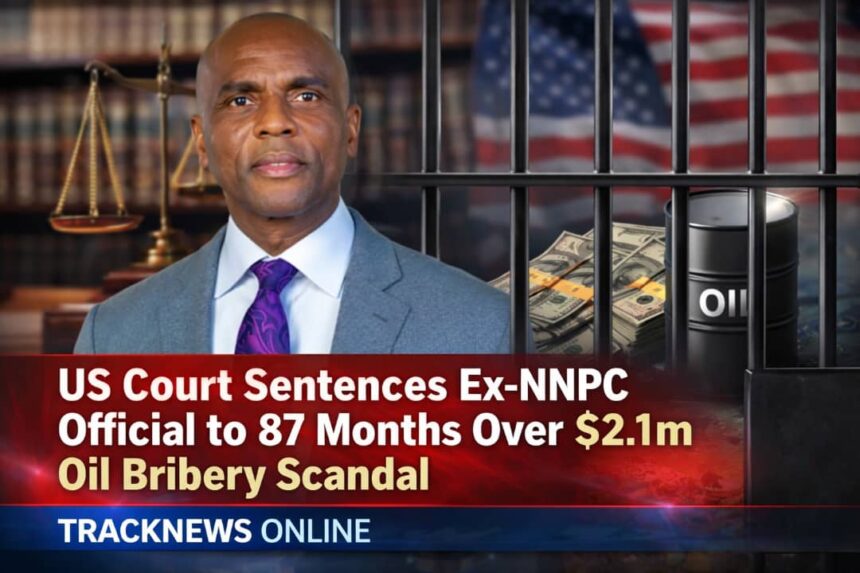
A United States district court has sentenced Paulinus Okoronkwo, a former senior official of the Nigerian National Petroleum Corporation (NNPC), to 87 months in prison for his role in a $2.1 million bribery scheme linked to oil drilling rights in Nigeria. The sentencing follows his conviction for accepting illicit payments from Addax Petroleum, a subsidiary of Chinese energy giant Sinopec.
According to court proceedings, Okoronkwo received the bribe in exchange for facilitating favourable drilling rights and business advantages for Addax Petroleum in Nigeria’s oil sector. The payments were made to influence official decisions and secure preferential treatment in the award and management of oil assets.
The U.S. court found that the former NNPC official abused his position of authority to benefit a private company in return for personal financial gain. Prosecutors detailed how the bribery arrangement undermined fair competition and compromised the integrity of Nigeria’s petroleum licensing processes.
In addition to the 87-month prison term, the court ordered Okoronkwo to forfeit assets linked to the proceeds of the crime. The ruling also included restitution payments to the United States Internal Revenue Service (IRS), reflecting financial violations connected to the case.
Authorities said the sentencing underscores continued international scrutiny of corruption in Nigeria’s oil and gas industry. The case was pursued under U.S. laws that address foreign corruption and financial crimes with cross-border implications.
Investigators revealed that the bribery scheme involved financial transactions routed through international banking systems, giving U.S. authorities jurisdiction in the matter. The prosecution argued that such corrupt arrangements distort global energy markets and erode public trust in governance.
Court documents showed that Okoronkwo held a senior position at NNPC at the time of the offence, enabling him to influence decisions concerning oil exploration and drilling contracts. His actions, prosecutors said, were calculated and deliberate.
The judgment marks a significant development in efforts by U.S. authorities to hold foreign officials accountable for corruption that touches the American financial system. It also reflects broader cooperation between international agencies in tackling transnational bribery.
Legal analysts noted that the case demonstrates how global enforcement agencies are increasingly targeting corruption linked to natural resource extraction. The oil sector, particularly in developing economies, has often been vulnerable to bribery and opaque contracting practices.
The court emphasized that public officials entrusted with managing natural resources must adhere to strict ethical standards. It stated that corruption in such sectors deprives citizens of the full benefits of national assets.
While details of Okoronkwo’s defence were not immediately available, the prosecution maintained that the evidence presented during trial clearly established the bribery arrangement. The court concluded that a substantial custodial sentence was warranted given the scale of the payments involved.
The forfeiture order is expected to recover funds and assets derived from the illegal payments. Restitution to the IRS addresses tax-related components of the financial misconduct associated with the bribe.
The sentencing sends a warning to corporate entities and public officials engaged in international business transactions. U.S. authorities reiterated their commitment to investigating and prosecuting corruption cases that involve the misuse of financial systems under their jurisdiction.
Observers say the case may further intensify calls for stronger transparency and accountability mechanisms within Nigeria’s oil industry. The sector remains a critical source of national revenue but has faced persistent allegations of corruption over the years.
The outcome of the trial highlights the far-reaching consequences of financial crimes in the global energy market. It also reinforces the role of international courts in addressing corruption that crosses national borders.
With the 87-month sentence handed down, Okoronkwo is expected to serve his term in a U.S. federal correctional facility, subject to standard regulations governing incarceration and supervised release.