
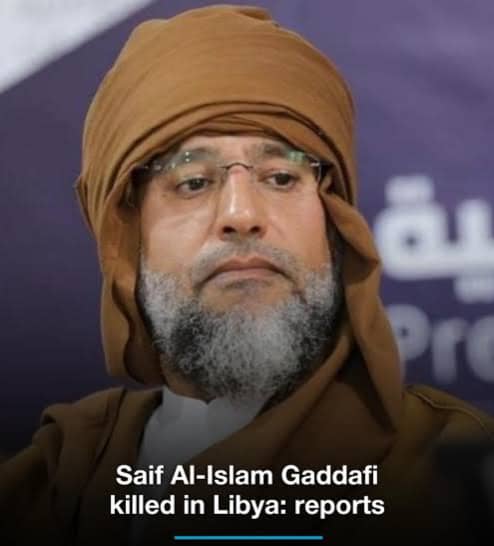
Saif al-Islam Gaddafi, the most prominent surviving son of late Libyan leader Muammar Gaddafi and a once-influential figure who attempted a political comeback amid the country’s prolonged chaos, has been killed in what appears to be a targeted assassination.
Multiple credible sources, including Reuters, Al Jazeera, BBC, Anadolu Agency, and his own political adviser and lawyer, confirmed the 53-year-old’s death on Tuesday.
He was shot and killed at his residence or private garden in Zintan, a mountainous town in northwestern Libya where he had lived in relative obscurity for much of the past decade.
According to reports from Libyan media and a source close to the Gaddafi family cited by Al Arabiya, four unidentified assailants carried out the attack around 2:30 a.m. local time.
The gunmen reportedly disabled surveillance cameras at the site before opening fire.
Saif al-Islam confronted the attackers but was fatally wounded, after which the perpetrators fled the scene. Details remain sparse, and no group has claimed responsibility.
An investigation has been launched, though Libyan authorities have yet to issue an official statement.
Saif al-Islam’s political adviser, Abdullah Othman, announced the death on social media, expressing mourning without providing further specifics on the circumstances.
His lawyer, Khaled el-Zaydi, also confirmed the killing to international outlets.
Once viewed as his father’s potential heir and the polished, Western-educated face of the Gaddafi regime, Saif al-Islam held significant influence before the 2011 Arab Spring uprising.
Educated in London and Vienna, he advocated for reforms while simultaneously playing a role in suppressing dissent during his father’s rule.
Following NATO-backed rebels’ overthrow of Muammar Gaddafi—who was captured and killed in October 2011—Saif al-Islam was apprehended by the Abu Bakr Sadik Brigade militia near the desert town of Obari.
He was held in Zintan for years, where he faced a 2015 death sentence in absentia from a Tripoli court for war crimes (later unexecuted).
Released under an amnesty in 2017, he largely disappeared from public view but maintained a low-profile presence in Zintan.
In a surprising move, he registered as a presidential candidate in 2021 ahead of Libya’s repeatedly postponed national elections, positioning himself as a unifying figure in a fractured country divided between rival administrations in Tripoli and Benghazi, as well as powerful militias and foreign-backed factions.
His candidacy was controversial—blocked by electoral authorities due to outstanding ICC warrants for crimes against humanity—and helped contribute to the election’s indefinite delay.Saif al-Islam’s killing removes the last major symbolic link to the Gaddafi era with genuine political capital.
Analysts suggest it could further complicate Libya’s path toward reconciliation and elections in a nation still reeling from militia rivalries, foreign interference, and economic collapse despite its vast oil reserves.
Reactions poured in quickly on social media platforms like X, with some users expressing grief over lost stability, while others speculated about motives tied to ongoing power struggles or foreign involvement—claims that remain unsubstantiated.
No immediate details have emerged regarding funeral arrangements or the recovery of his body, though sources indicated efforts were underway.
The incident underscores the persistent volatility in post-Gaddafi Libya, where political figures remain vulnerable to targeted violence.