
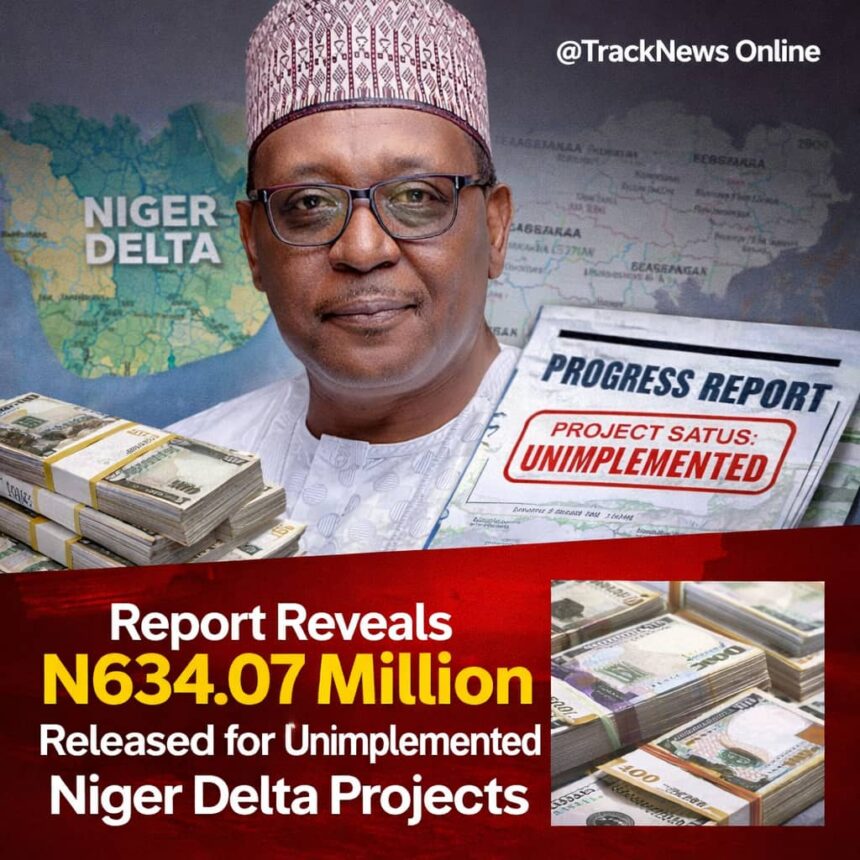
A newly released report by Tracka has revealed that N634.07 million was disbursed for several Niger Delta projects that were never implemented. According to the report, the funds were released from government accounts but no corresponding work was carried out on the identified projects. The disclosure has raised concerns about public financial management and oversight.
The report indicates that despite the substantial release of funds, the projects in question did not commence at all. This means that public resources were expended without delivering any tangible benefit to citizens in the affected communities. The findings have sparked renewed debate about accountability in government spending.
The revelation comes at a time when public sector funding constraints are affecting critical sectors. In contrast to the N634.07 million reportedly released for the unexecuted Niger Delta projects, the Honourable Minister of Health recently disclosed that only N36 million was released to the Ministry of Health in the 2025 budget cycle. The comparison has drawn sharp attention to the allocation and utilization of limited public resources.
Financially, N634.07 million is more than 17 times the amount reportedly released to the Ministry of Health this year. Stakeholders argue that such a sum could have significantly strengthened Nigeria’s primary healthcare system if properly deployed. The disparity has intensified calls for improved budgetary discipline and monitoring.
Health sector advocates note that N634 million could potentially fund the renovation and equipping of between 100 and 150 Primary Health Care Centres across the country. Basic facility upgrades such as roofing, flooring, water supply, and solar power installations could be addressed with such funding. Many rural facilities currently operate in dilapidated conditions, limiting access to essential services.
The funds could also have supported the procurement of thousands of delivery beds, hospital mattresses, and other critical medical equipment. Several Primary Health Care Centres lack even the most basic tools required for maternal and child healthcare. Equipment shortages often force patients to travel long distances in search of better-equipped facilities.
In addition, the amount could have financed essential drugs and vaccines to prevent stockouts in multiple rural communities. Interruptions in medical supplies continue to affect immunisation coverage and routine treatment services. Reliable funding is considered crucial to maintaining consistent access to lifesaving medicines.
Healthcare experts further point out that the resources could have supported recruitment drives or deployment incentives for community health workers and midwives in underserved areas. Staffing shortages remain a major challenge in rural health centres. Incentive programmes are often necessary to attract skilled professionals to remote locations.
The installation of solar-powered cold chain systems to safeguard immunisation programmes is another intervention that could have been supported. Many facilities struggle with unreliable electricity, affecting vaccine preservation. Strengthening cold chain infrastructure is viewed as essential to improving immunisation outcomes.
Nigeria currently accounts for approximately 27 percent of global maternal mortality, according to international health data. Poor immunisation coverage and deteriorating rural health infrastructure continue to contribute to preventable deaths. Analysts argue that every unimplemented public project represents not just financial inefficiency but missed opportunities to improve lives.
The central issue raised by the report is one of accountability rather than scarcity alone. Observers question how funds could be released without mechanisms ensuring project execution. The situation has prompted calls for clearer oversight structures and enforcement measures.
Public finance experts emphasize that budget announcements and fund releases must translate into measurable outcomes. Effective governance requires that appropriated funds result in completed projects and functional services. Without implementation, budgetary allocations fail to achieve their intended purpose.
In response to the findings, there have been calls for anti-corruption agencies to intervene. The Economic and Financial Crimes Commission and the Independent Corrupt Practices Commission have been urged to investigate the contractors linked to the projects. Advocates are demanding urgent action to determine responsibility and prevent recurrence.
The report’s revelations have renewed scrutiny of public expenditure management in Nigeria. As citizens grapple with economic pressures and strained public services, questions surrounding transparency and project delivery remain central to national discourse.