

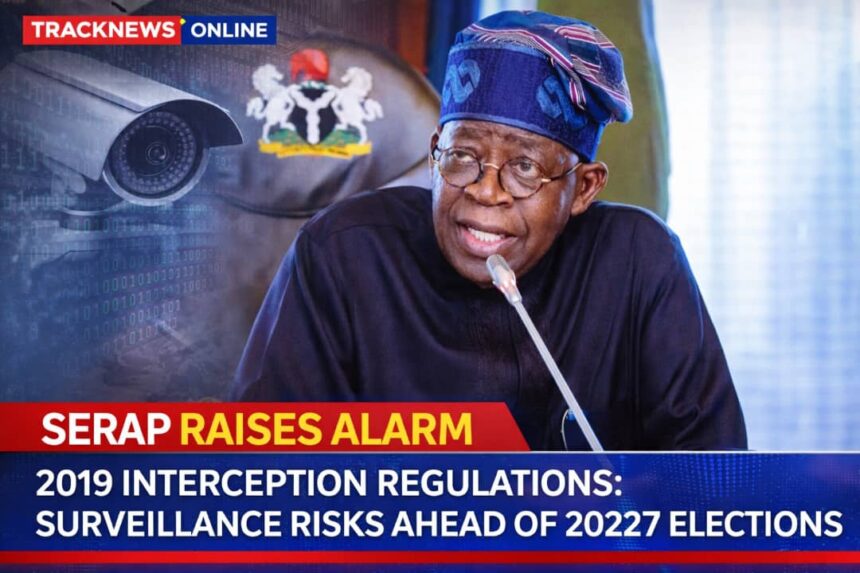
The Socio-Economic Rights and Accountability Project has warned that Nigeria’s Lawful Interception of Communications Regulations 2019 could expose citizens to unchecked government surveillance, raising concerns about privacy, free expression and the integrity of future elections.
In a statement, SERAP said the regulations could effectively turn mobile phones and digital communication platforms into monitoring tools targeting journalists, activists, political critics and ordinary Nigerians.
The group issued a seven-day ultimatum to President Bola Tinubu’s administration to withdraw the regulations. It called for the rules to be subjected to full legislative scrutiny and strengthened with judicial safeguards.
The regulations were issued by the Nigerian Communications Commission. They empower security agencies to intercept calls, text messages and data communications under broad grounds such as “national security” and “economic stability.”
SERAP argued that the provisions lack clear requirements for prior judicial authorization, proportionality limits and adequate protections against abuse. According to the organization, the absence of explicit safeguards increases the risk of arbitrary or politically motivated surveillance.
Kolawole Oluwadare, SERAP’s Deputy Director, said in correspondence addressed to the president that such far-reaching powers should undergo proper legislative review. He warned that unchecked interception authority could violate Section 37 of the 1999 Constitution, which guarantees the right to privacy.
The group also cited Nigeria’s obligations under international human rights instruments. It stated that surveillance measures must be lawful, necessary and proportionate, and subject to independent oversight.
Concerns about the regulations have intensified following allegations of phone tapping involving high-profile public figures. Claims have circulated that the Office of the National Security Adviser, headed by Nuhu Ribadu, intercepted private communications, although no official confirmation has been issued regarding those specific allegations.
SERAP said that without reforms, the regulations could be “weaponized” ahead of the 2027 general elections. It warned that surveillance powers might be used to monitor critics, suppress dissent, intimidate journalists and discourage political organizing.
The organization maintained that the prospect of widespread interception could create a chilling effect on free speech. Citizens who fear monitoring, it said, may be less willing to express opinions, engage in activism or participate openly in political processes.
SERAP has previously challenged similar measures, including proposals to monitor encrypted messaging platforms such as WhatsApp. The group has consistently argued that national security concerns must not override constitutional freedoms.
Legal analysts note that lawful interception frameworks exist in many countries. However, they emphasize that such regimes typically require judicial warrants, defined time limits and independent oversight to prevent misuse.
As of the time of the statement, the federal government had not publicly responded to SERAP’s ultimatum. The Nigerian Communications Commission has also not issued a new clarification regarding the scope or implementation safeguards of the 2019 regulations.
The debate comes amid heightened political activity as preparations gradually begin toward the 2027 general elections. Advocacy groups say clear legal boundaries and transparent oversight mechanisms are essential to maintaining public trust.
SERAP warned that failure to amend or withdraw the regulations could contribute to online censorship, intimidation of journalists and arbitrary surveillance. The organization said it would consider further legal action if its demands are not addressed within the specified timeframe.
The development has renewed public discussion about balancing national security priorities with the protection of civil liberties in Nigeria’s evolving digital landscape.