
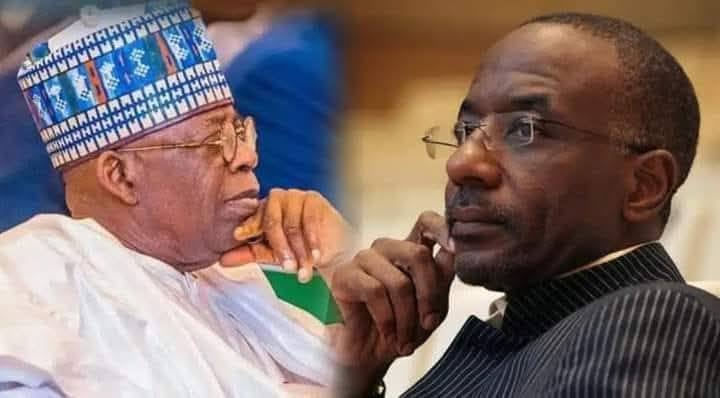
Former Central Bank of Nigeria Governor and Emir of Kano, Sanusi Lamido Sanusi, has raised fresh concerns about Nigeria’s economic direction, questioning why the federal government continues to borrow despite removing fuel subsidies. His remarks, captured in a widely circulated video, have sparked renewed debate over the country’s fiscal and monetary policies.
Sanusi’s comments come at a time of heightened public concern over rising living costs and currency instability. While he reaffirmed his longstanding position that the fuel subsidy regime was unsustainable, he expressed reservations about the sequencing and broader implementation of recent economic reforms under President Bola Tinubu’s administration.
He stated that maintaining fuel subsidies in the past had placed a heavy burden on Nigeria’s economy, particularly as the country relied on imported refined petroleum products despite being an oil-producing nation. According to him, this approach effectively meant subsidising foreign refineries, a practice he described as economically damaging.
Sanusi pointed to recent developments in the oil sector as a positive shift, noting that Nigeria now has domestic refining capacity and is no longer heavily dependent on imports. He said the country has even begun exporting petroleum products to Europe, describing the trend as beneficial for the economy.
Despite his support for subsidy removal and exchange rate liberalisation, Sanusi questioned whether the policies were introduced at the appropriate time and with adequate supporting measures. He stressed that reforms of such magnitude must be carefully sequenced to avoid destabilising economic shocks.
Addressing exchange rate management, he criticised the use of artificial controls, arguing that they are unsustainable, particularly in an environment where money supply is expanding. He warned that such policies inevitably lead to currency devaluation and broader economic distortions.
Sanusi also highlighted the importance of tightening monetary conditions before implementing major fiscal reforms. He cautioned that removing subsidies and liberalising exchange rates in a context of loose monetary policy could accelerate the depreciation of the naira, a situation he described as avoidable with better timing.
Turning to Nigeria’s fiscal situation, Sanusi said the country’s rising debt burden had made subsidy removal unavoidable. He noted that at one point, all government revenue was being used to service debt, leaving little room for other expenditures.
However, he expressed concern that the expected fiscal relief from subsidy removal has not translated into reduced borrowing. He questioned the rationale behind continued debt accumulation, arguing that the government should demonstrate clear benefits from the policy changes.
Sanusi emphasised the need for fiscal discipline, urging authorities to ensure that savings from subsidy removal are effectively managed. He warned against what he described as wasteful borrowing practices, insisting that eliminating inefficiencies should go hand in hand with reducing reliance on loans.
He further argued that economic policies should not be assessed in isolation, but rather as part of a broader framework that includes complementary reforms. Without such coordination, he suggested, even well-intentioned policies could fail to deliver the desired outcomes.
His remarks have added to ongoing national conversations about the impact of recent economic reforms, with many Nigerians grappling with inflationary pressures and declining purchasing power. As debates continue, Sanusi’s intervention underscores the complexities of balancing fiscal sustainability with economic stability in a challenging environment.