
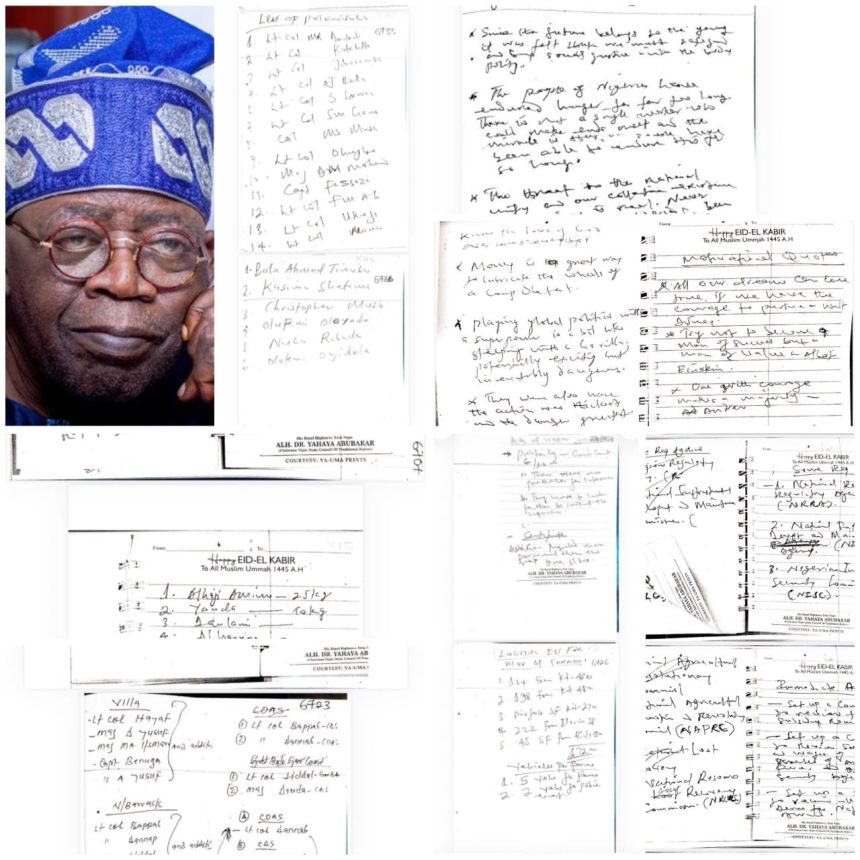
Fresh revelations have emerged in the ongoing investigation into the alleged coup plot against President Bola Ahmed Tinubu’s administration, following the discovery of a handwritten document said to contain plans for a replacement government if the operation had succeeded.
The document, reportedly recovered during investigations and reviewed by Pointblanknews.com, allegedly outlined proposed political appointments and administrative structures intended to take effect after the planned removal of the Tinubu government.
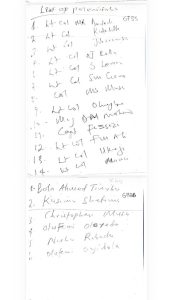
Among the positions listed were “Leader of New Nigeria and Commander-in-Chief,” a Vice President or Prime Minister as second-in-command, Chief of Army Staff, Secretary to the Government of the Federation, Attorney-General of the Federation and National Security Adviser.
Top positions in security and anti-corruption agencies, including the Economic and Financial Crimes Commission (EFCC) and the Department of State Services (DSS), were also reportedly captured in the notes.
Investigators further claimed the alleged plotters proposed the establishment of a “National Patriotic Ruling Council” (NPRC), a body said to mirror the Armed Forces Ruling Council that operated during Nigeria’s military era.
The handwritten document allegedly contained plans to create new government agencies, including the National Religion Regulatory Agency, National Infrastructure Development Maintenance Agency and the Nigerian Internal Security Committee.
Other proposals reportedly included setting up committees to review the final removal of petroleum subsidy and improve salaries and welfare packages for members of the armed forces and other security agencies.
Security sources said the alleged conspirators also planned a major restructuring of the military into six command zones, with three General Officers Commanding assigned to each zone.
Another proposal allegedly involved merging the EFCC with the Independent Corrupt Practices and Other Related Offences Commission (ICPC).
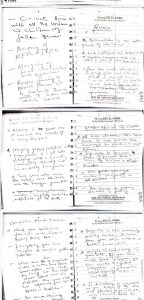
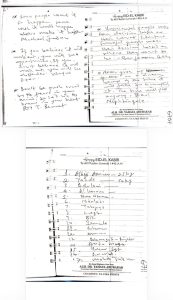
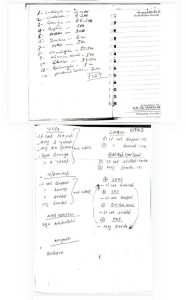
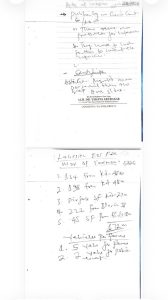
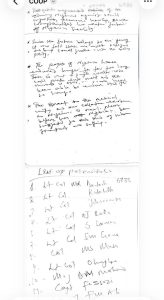
According to details contained in the notes, several positions in the proposed administration were to be allocated using the federal character principle.
The Vice President position was allegedly zoned to the South East, while the Secretary to the Government of the Federation and Minister of Defence were designated for the South West.
The Attorney-General of the Federation and Chief of Defence Staff were reportedly assigned to the South South, while the National Security Adviser position was to go to the North West.
The EFCC chairmanship was allegedly reserved for the North East, while the Director-General of the DSS and Inspector-General of Police were expected to emerge from the North Central region.
Although portions of the handwritten notes reportedly remain difficult to interpret, investigators believe the document formed part of the operational framework of the alleged coup planners.
The revelations have added a new dimension to the ongoing treason and terrorism trial before the Federal High Court in Abuja.
The Federal Government had announced in January 2026 that security agencies uncovered an alleged plot involving serving and retired military officers, alongside civilians, to overthrow President Tinubu’s administration.
Subsequent investigations led to several arrests, while some suspects were declared wanted by authorities.
Those currently facing trial include retired Major General Mohammed Ibrahim Gana, retired Naval Captain Erasmus Ochegobia Victor, Police Inspector Ahmed Ibrahim, Zekeri Umoru, Bukar Kashim Goni and Abdulkadir Sani.
Former Bayelsa State Governor Timipre Sylva was also named in court documents as allegedly linked to the plot and was reported by prosecutors to be at large.
Prosecutors accused the defendants of conspiring to destabilise the democratically elected government and attempting to “levy war against the state.”
The charges include treason, terrorism, conspiracy and alleged terrorism financing.
The case has attracted nationwide attention and is regarded as one of the most serious alleged coup investigations since Nigeria returned to democratic rule in 1999.
During recent proceedings, the Federal High Court ordered an accelerated hearing of the matter, while journalists were reportedly restricted from parts of the trial due to security concerns.
Witnesses from the Nigerian Army and intelligence agencies have already begun giving testimony before the court.
One prosecution witness told the court that intelligence reports initially exposed suspicious meetings and covert communications involving some of the accused persons.
Investigators also alleged that encrypted messaging platforms and secret coordination channels were used during the planning stages of the alleged operation.
All defendants have pleaded not guilty to the charges and remain in DSS custody pending the hearing of their bail applications and continuation of the trial.