

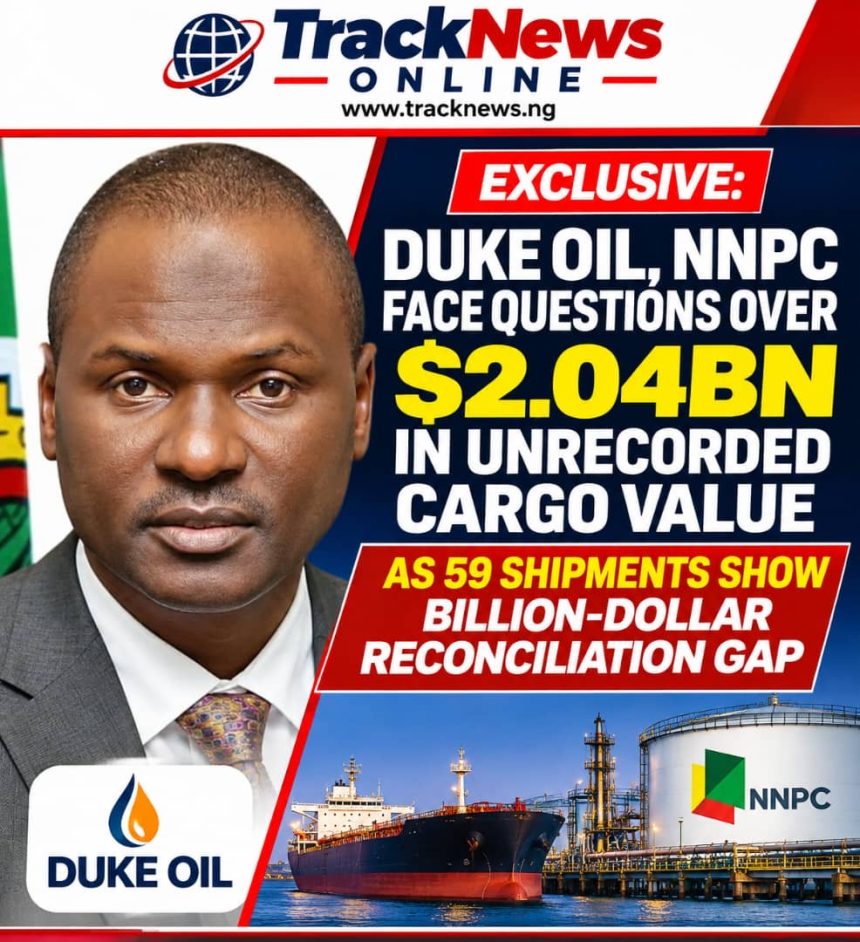
A breakdown of ledger records covering 59 petroleum cargoes shipped between 2022 and 2023 has revealed a combined cargo value of approximately $2.99 billion, against recorded payments of about $952.49 million, leaving approximately $2.04 billion unrecorded in the dollar-denominated entries.
The records raise significant questions about the reconciliation of petroleum cargo proceeds involving Duke Oil Company, a wholly owned offshore subsidiary of the Nigerian National Petroleum Company Limited (NNPC Ltd), and the accounting treatment of revenues belonging to the Federation.
The year-by-year breakdown shows that in 2022, the ledger recorded 34 cargoes valued at $1,959,225,906. Of this amount, $383,425,220 was recorded as paid, leaving $1,575,800,686 unrecorded.
In 2023, another 25 cargoes were valued at $1,032,810,783, with recorded payments of $569,067,388, leaving $463,743,394 unrecorded.
Altogether, the 59 cargoes had a recorded value of $2,992,036,689, while payments amounted to $952,492,608. The combined unrecorded balance was approximately $2,039,544,080, subject to a one-dollar discrepancy in the supplied annual figures.
The figures raise questions about where the outstanding value was accounted for, whether the transactions were subsequently settled through other group accounting entries, and whether the Federation’s entitlements were fully recognised and reconciled.
### CONSTITUTIONAL AND PETROLEUM INDUSTRY ACT PROVISIONS
Section 162(1) of the Constitution of the Federal Republic of Nigeria 1999 requires revenues collected by the Government of the Federation to be paid into the Federation Account, subject to the applicable constitutional provisions.
Similarly, Section 64(m) of the Petroleum Industry Act 2021 provides for NNPC Ltd to act as the supplier of last resort for petroleum products, with the associated costs borne by the Federation.
This provision forms part of the legal basis for the under-recovery treatment reflected in the ledger entries, where certain amounts were netted at source.
However, the accounting treatment of under-recovery does not remove the obligation to properly account for the underlying transactions and the respective entitlements.
The Federation’s share, alongside amounts attributable to the Federal Inland Revenue Service and the Nigerian Upstream Petroleum Regulatory Commission, must be properly identified and reconciled in accordance with the applicable legal and fiscal framework.
A transfer of value between NNPC Ltd and its wholly owned offshore subsidiary does not, by itself, establish that the underlying obligation to account for the proceeds has been discharged. Such transactions must be supported by verifiable settlement records and properly reflected in the relevant group accounts.
### POTENTIAL LEGAL IMPLICATIONS
The legal implications could become more serious if an investigation establishes that any of the cargoes or their proceeds were diverted, or obtained through false pretences.
Section 419 of the Criminal Code addresses obtaining property by false pretences and provides for criminal liability, including imprisonment of up to three years.
Furthermore, Section 1 of the Advance Fee Fraud and Other Fraud Related Offences Act 2006 prescribes imprisonment of not less than seven years and not more than twenty years, without the option of a fine, for offences established under the provision.
Any credible evidence of financial diversion or fraudulent transactions could also warrant investigation by the Economic and Financial Crimes Commission (EFCC) under the Economic and Financial Crimes Commission (Establishment) Act 2004.
However, the ledger figures alone do not establish criminal diversion, false pretence or wrongdoing by Duke Oil Company or NNPC Ltd. Nor do they independently establish that the entire unrecorded balance represents missing money.
The distinction between an unrecorded payment, an outstanding receivable, an accounting adjustment, an under-recovery deduction and an actual diversion of funds must be established through a detailed examination of the underlying transactions.
### DUKE OIL, NNPC MUST EXPLAIN THE $2.04BN GAP
The central question is whether the approximately $2.04 billion outstanding in the dollar-denominated ledger entries was subsequently settled, recognised through other verifiable accounting entries, or remains an outstanding obligation.
Duke Oil Company and NNPC Ltd must provide a comprehensive reconciliation of all 59 cargoes, including bills of lading, invoices, cargo proceeds, bank settlement records, subsidiary-to-parent transactions, under-recovery deductions and the respective Federation entitlements.
The reconciliation should establish how much was received, how much was paid, what was deducted, what remains outstanding and how the transactions were ultimately reflected in the accounts of both entities.
Ultimately, the issue is not merely the movement of petroleum cargoes or the relationship between NNPC Ltd and its offshore subsidiary. It is whether the full value of the Federation’s petroleum resources has been transparently accounted for and whether all legally recognised government entitlements have been properly reconciled.
**TRACKNEWS ONLINE — EXCLUSIVE INVESTIGATIVE REPORT**