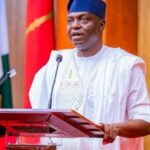


The Igbo Community Stakeholders, Lagos State Chapter, have raised concerns over ongoing commercial disputes involving Igbo-owned businesses in Lagos, citing Nestoil and issues linked to major financial institutions, including First Bank, as part of a broader pattern that they say raises questions about fairness and due process in Nigeria’s business environment.
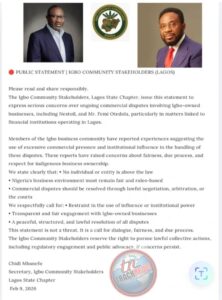
In a public statement issued in Lagos on February 9, 2026, the group said it was worried about what it described as excessive commercial pressure and the use of institutional influence in the handling of certain disputes involving indigenous enterprises operating within the state.
The stakeholders stated that recent developments surrounding some high-profile commercial disagreements had drawn their attention, particularly where large financial institutions and influential business figures are involved. They said such cases have the potential to undermine confidence in Nigeria’s commercial and legal systems if not handled transparently and in line with established laws.
According to the group, the situation has sparked wider concern within the Igbo business community, especially regarding respect for indigenous business ownership and the consistent application of due process in resolving financial and corporate disputes.
The statement noted that the group’s intervention was guided by principles of equity, justice, and the rule of law, emphasizing that no individual, corporate body, or institution should be perceived as being above legal scrutiny.
“We believe Nigeria’s business environment must remain fair, transparent, and rules-based,” the stakeholders said, stressing that commercial disagreements should be addressed strictly through lawful mechanisms.
They added that globally accepted processes such as negotiation, arbitration, and adjudication through the courts remain the appropriate channels for resolving disputes between corporate entities and financial institutions.
The group warned that the misuse of influence or institutional power in business conflicts could discourage investment, weaken trust in regulatory frameworks, and create uncertainty for indigenous entrepreneurs operating in competitive markets such as Lagos.
They further called on all parties involved in the disputes to exercise restraint and to ensure that engagements with Igbo-owned enterprises are conducted openly, fairly, and in accordance with the law.
The stakeholders made it clear that their statement was not intended to inflame tensions or issue threats, but rather to promote dialogue and constructive engagement among all parties concerned.
“This statement is not a threat. It is a call for dialogue, fairness, and due process,” the group said, reiterating its commitment to peaceful and lawful advocacy.
They also emphasized the importance of protecting Nigeria’s diverse business ecosystem, noting that Lagos remains a commercial hub where businesses from all regions and backgrounds should be able to operate without fear of undue pressure or discrimination.
While reaffirming their dedication to peace and legal engagement, the Igbo Community Stakeholders stated that they would not hesitate to explore lawful collective actions if their concerns are not adequately addressed.
Such actions, they said, could include formal engagement with regulatory authorities, petitions to relevant oversight bodies, and public advocacy aimed at drawing attention to issues affecting indigenous businesses.
The group stressed that any future steps would be taken strictly within the bounds of the law and in line with democratic principles.
The statement was signed by Chidi Mbanefo, Secretary of the Igbo Community Stakeholders, Lagos State Chapter, who said the group remains open to dialogue and constructive solutions that uphold fairness and strengthen confidence in Nigeria’s commercial dispute resolution processes.
The development comes amid broader conversations about corporate governance, financial sector practices, and the treatment of indigenous enterprises within Nigeria’s evolving business landscape, particularly in Lagos, which serves as the country’s economic nerve centre.