

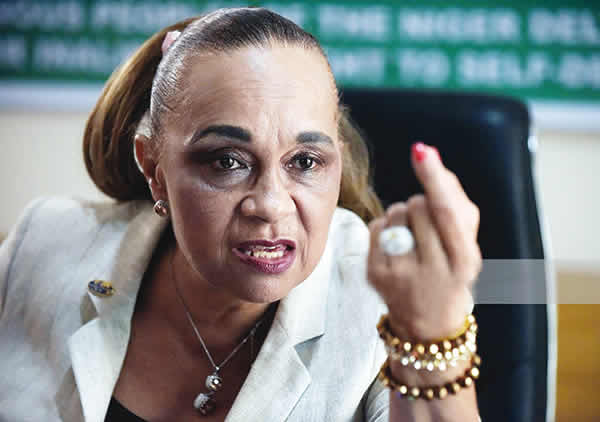
Niger Delta rights activist, Annkio Briggs, has said that the people of Rivers State, not members of the State House of Assembly, hold the ultimate authority over who governs the state, insisting that Governor Siminalayi Fubara enjoys the support of the populace to remain in office beyond 2027.
Briggs made the assertion while reacting to the ongoing impeachment controversy involving Governor Fubara and the Rivers State House of Assembly. She spoke during an interview on Channels Television on Thursday, where she strongly criticised what she described as attempts by lawmakers to override the will of the people.
According to Briggs, the democratic power to determine leadership in Rivers State rests squarely with the electorate. She argued that lawmakers do not possess the authority to dictate who the people should vote for in future elections or to impose political outcomes against the public interest.
She stated that her primary concern is the apparent failure of some legislators to understand the limits of their powers within a democratic system. Briggs said the people of Rivers State, through their votes, are the true custodians of political power, not elected lawmakers acting on their own interests.
Briggs stressed that members of the Rivers State House of Assembly cannot assume the role of deciding the political future of the state. She said such decisions belong to the people alone and warned that any attempt to undermine this principle could have serious political consequences.
Speaking further, the Niger Delta activist called on the federal government to pay close attention to the unfolding political situation in Rivers State. She specifically appealed to President Bola Tinubu to ensure that democratic norms are upheld and that the will of the people is respected.
Briggs also directed her comments to the All Progressives Congress, urging the ruling party to exercise caution in its handling of the Rivers State political crisis. She noted that Governor Fubara has been received into the APC, alongside members of the State House of Assembly, making the situation particularly sensitive for the party.
According to her, the APC must be mindful of its actions as it prepares for upcoming elections. She warned that mismanaging the Rivers State situation could affect the party’s chances, not only in the state but across the wider Niger Delta region.
Briggs pointed out that Rivers State plays a significant role in the political landscape of the Niger Delta. She said the way the APC conducts itself in the state would influence how the party is perceived by voters throughout the region.
She cautioned that the party’s approach to internal conflicts and governance issues could either strengthen or weaken its support base ahead of the next general election cycle. Briggs emphasized that securing the trust and votes of Rivers people requires respect for democratic processes and popular opinion.
The activist also highlighted the broader implications of the impeachment saga, describing it as more than a local political dispute. She said it reflects ongoing struggles over power, representation, and democratic accountability in the state.
Briggs reiterated her belief that Governor Fubara has the backing of the people and argued that any attempt to remove him through legislative manoeuvres would amount to disregarding the electorate’s mandate. She said Rivers residents are politically aware and capable of deciding their own future.
She added that political actors must recognise that authority in a democracy flows from the people, not from political offices or institutions acting independently of public will. According to her, ignoring this reality could deepen political tensions and erode public trust.
Briggs concluded by urging all stakeholders, including lawmakers, political parties, and the federal government, to respect the voice of Rivers people. She maintained that lasting political stability in the state can only be achieved by allowing citizens to freely determine their leadership through the ballot box.