
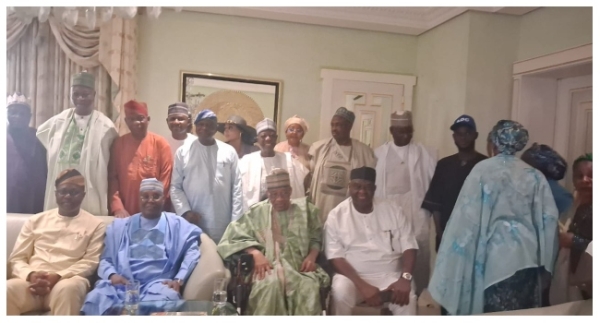
Former Vice President Atiku Abubakar on Tuesday, February 10, held a closed-door meeting with former Military President Ibrahim Babangida at his residence in Minna, Niger State. The meeting, which lasted several hours, focused on political developments and efforts to strengthen the African Democratic Congress (ADC), according to Atiku.
Oyo State Governor Seyi Makinde was also present in Minna on the same day. However, his visit was separately described as private and not directly connected to Atiku’s engagement with the former military leader.
Speaking with journalists after the meeting, Atiku dismissed speculation that his visit was tied to any ambition to contest the 2027 presidential election. He stated clearly that his current political engagements are not about personal aspirations but about broader democratic reforms.
“At this point, this is not about me contesting elections,” Atiku said. He added that the focus is on addressing concerns raised by Nigerians regarding the credibility of elections, particularly the transmission of results.
The former vice president stressed that many Nigerians are demanding the electronic transmission of election results in real time. According to him, this measure is widely seen as a way to improve transparency and reduce disputes that often arise after elections.
He criticized the existing system, which combines electronic transmission with manual processes. Atiku described the approach as confusing and capable of creating unnecessary controversy.
“The preference of Nigerians is clear,” he said. “What we have now is a mixture of electronic and manual uploading, which only causes confusion and chaos.”
Atiku argued that a clear and consistent electronic process would help strengthen public confidence in the electoral system. He maintained that electoral transparency remains a critical issue in Nigeria’s democratic development.
He also called on opposition parties to work together in addressing the Senate’s position on electronic transmission of results. According to him, the matter should not be ignored, as it directly affects the integrity of future elections.
The former vice president emphasized that collaboration among political stakeholders is essential to achieving meaningful reform. He said opposition groups must remain united in pushing for changes that reflect the wishes of the electorate.
In addition to electoral reforms, Atiku confirmed his membership in the African Democratic Congress. He disclosed that the party is intensifying grassroots mobilization efforts across the country.
According to him, the ADC is building structures from the ward level up to the national stage. He said the goal is to strengthen the party’s presence and ensure it is well-positioned for future political engagements.
Atiku arrived in Minna at approximately 1:30 p.m. He was accompanied by several prominent ADC figures, including former Osun State Governor Olagunsoye Oyinlola and Senator Ben Obi, along with other party stakeholders.
While Atiku did not disclose specific details of his discussion with Babangida, he noted that this was not his first visit to the former military ruler. He described Babangida as an elder statesman whose views and experiences remain relevant in national discourse.
The meeting has drawn attention amid ongoing conversations about political alignments and reforms ahead of future elections. However, Atiku maintained that the purpose of the visit was centered on strengthening democratic processes rather than advancing personal political ambitions.
Political observers note that engagements with influential figures such as Babangida often signal consultations on national issues. Still, Atiku insisted that his primary concern remains electoral reform and the consolidation of democratic principles.
The renewed focus on electronic transmission of results comes amid broader debates about the conduct of elections in Nigeria. Calls for greater transparency have grown in recent years, particularly following disputes over the handling and announcement of results.
Atiku’s remarks in Minna reinforce his long-standing advocacy for electoral reforms. He reiterated that ensuring credible elections is essential for national stability and public trust in democratic institutions.
As the ADC continues its nationwide mobilization, party leaders appear to be positioning themselves around issues they believe resonate with voters. For Atiku, the emphasis remains on reforming the electoral system and responding to what he described as the clear preference of Nigerians for a more transparent voting process.