
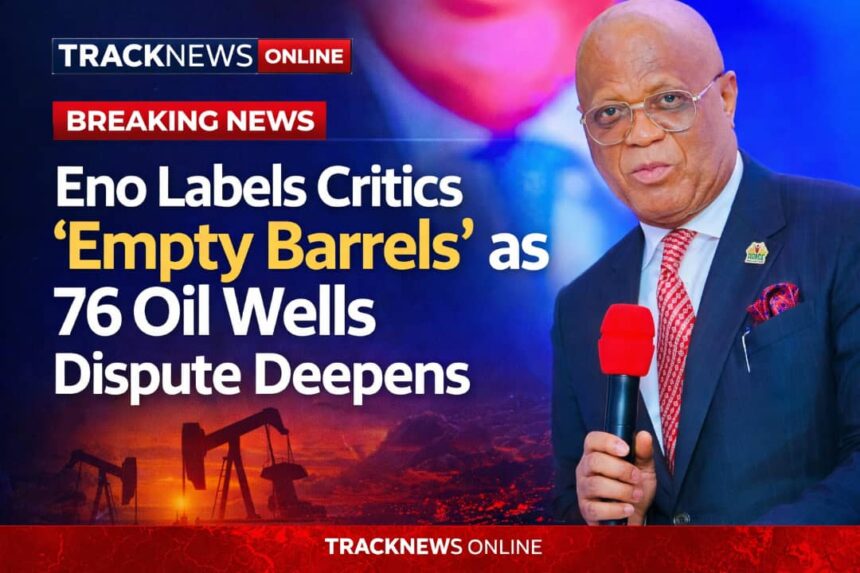
Governor Umo Eno of Akwa Ibom State has defended his administration amid growing criticism over the disputed 76 oil wells, describing his critics as “empty barrels” making unnecessary noise. The governor made the remarks on Sunday during the monthly church service held at the Government House in Uyo.
Mr Eno rejected claims that he had been inaccessible on the matter and responded sharply to suggestions that he failed to return phone calls. He said he was not a receptionist and should not be expected to personally answer every call directed to him.
“There are many ways to reach the governor,” he said. “Stop saying the governor does not pick up the phone. Am I your receptionist? That is even an insult to say the governor does not answer calls. Who are you? Who is even talking?”
Although the governor did not mention any individual by name, his comments appeared to be directed at former senator John Akpanudoedehe. The former lawmaker had recently issued public statements expressing concern over the handling of the 76 oil wells dispute.
Mr Akpanudoedehe had advised the governor not to allow the state to lose control of the oil wells. He warned that failure to defend the state’s interest would have lasting political consequences.
Responding indirectly, Mr Eno criticised those he said were politicising a matter that affects all citizens of the state. He questioned why the issue was being turned into a political contest rather than addressed collectively.
“Must everything be politics? Something that has to do with all of us,” the governor said. “If you know what else to do, why not approach us? At this time, we need prayers.”
He also dismissed his critics as individuals who had previously held public office but failed to make meaningful contributions. According to him, those who genuinely worked for the state were not the ones making public noise.
“All of them making noise were in government at one time or another. Ask them what exactly they brought back home?” he said. “Those that brought things back home are not talking. They are helping.”
The governor described the criticism as “comic relief,” stating that he sometimes found the online commentaries amusing after long workdays. He also took aim at senior politicians who post videos online, suggesting they were motivated by financial gain rather than patriotism.
“This one comes on TV and makes a video. He is creating content to get money,” he said. “Big old men creating content so that they can drive traffic for Google to pay money. Are you really serious? Is this patriotism?”
The dispute escalated after Mr Akpanudoedehe, on 19 February, addressed the issue in a Facebook Live broadcast. In the video, he claimed he had struggled to reach the governor by phone and decided to speak publicly out of concern for the state.
“I have been trying to reach the governor, but he barely returns calls,” he said. “You may see me as someone from the opposition, but I have the interest of Akwa Ibom at heart.”
He warned that losing the oil wells would undermine the sacrifices of past leaders and citizens who fought to secure them for the state. He stated that such an outcome would not be forgiven by the people.
“With so much resources and political reach at your disposal, if you allow it to happen, you will be seen as a weak and unprepared governor,” he said.
In a subsequent video released on 22 February, the former senator referenced his involvement during the administration of former President Olusegun Obasanjo. He said he played a key role in efforts to secure the oil wells for Akwa Ibom.
He also cited the tenures of former Governors Victor Attah and Godswill Akpabio, suggesting that the oil wells would not have been lost under their leadership.
On Monday, Mr Akpanudoedehe responded to the governor’s comments. He said he would not engage in personal attacks and preferred to allow residents of the state to judge the exchange.
“There are things to respond to immediately. There are things you are not supposed to respond to,” he said. “I don’t respond to insults. I was advising him. I don’t want to go to the gutters with him.”
He added that he had expected appreciation rather than dismissal, stressing that his intervention was intended as constructive advice. According to him, he was speaking from experience and concern for the state’s future.
The exchange has generated reactions from citizens, particularly on social media. Many commenters criticised the governor’s tone and urged more respectful engagement on issues of public importance.
David Okon, reacting in the comment section of a local newspaper’s Facebook page, described Mr Akpanudoedehe as a seasoned politician deserving of respect. He emphasised that public office is temporary and held in trust for the people.
Michael Akpanidem said respectful communication was essential in governance and affirmed that every citizen had the right to express concerns about the oil wells. Another resident, Itoro Udoada, expressed disappointment and reminded political leaders that power is transient.
The 76 oil wells dispute remains a sensitive issue in Akwa Ibom, given its economic implications for the oil-producing state. As public debate continues, attention is focused on how the administration will address concerns over the ownership and control of the oil wells.