
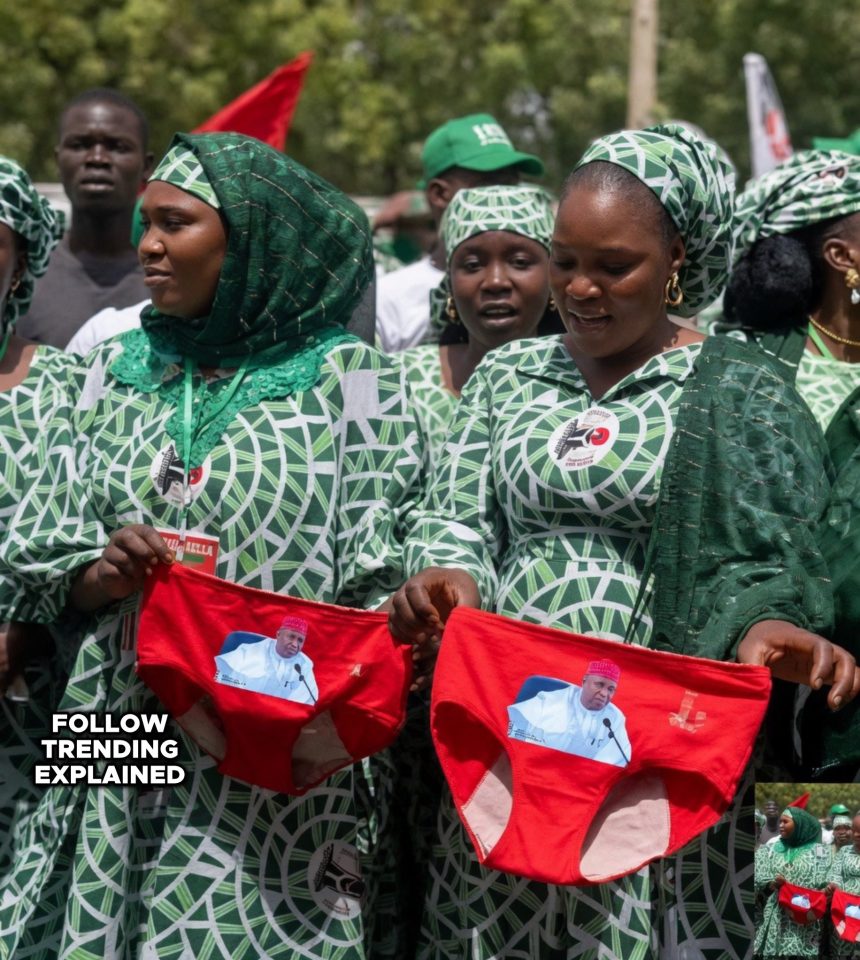
A fresh political controversy has emerged in Kano State after allegations surfaced that women’s underwear bearing the image of Governor Abba Kabir Yusuf was distributed as part of political mobilisation efforts. The claims, which have not been officially confirmed, have sparked widespread reactions across social media and among residents.
The issue gained attention after photos began circulating online showing women’s pants reportedly printed with what appears to be the governor’s campaign-style poster displayed prominently on the front. The images quickly went viral, drawing criticism from many Nigerians who described the act as inappropriate and disrespectful.
Several commentators argued that the alleged distribution reflects a troubling approach to political campaigning. They said such materials degrade women and reduce them to tools for political gain, rather than engaging voters through meaningful policies or programmes.
The controversy has also fueled debate about the authenticity of the images. While some critics directed their anger at the governor and his supporters, others questioned whether the materials were genuine or possibly fabricated to damage his reputation. This has led to speculation that political opponents could be responsible for circulating the photos in an attempt to discredit him ahead of future elections.
Supporters of Governor Yusuf have strongly denied any connection between the alleged items and the state government or its political structures. They emphasized that no official campaign team or government agency has announced or endorsed such an initiative.
They also warned against the spread of unverified information, arguing that such claims could inflame political tensions in Kano. According to them, the circulation of the images without confirmation risks misleading the public and undermining trust in political discourse.
As of the time of reporting, the Kano State Government has not released any formal statement addressing the allegations. The absence of an official response has further fueled speculation and prolonged the public debate.
Many observers have called for a thorough investigation to determine the origin of the materials and verify whether there is any link to political actors within the state. They stressed the need for clarity to prevent misinformation and protect the integrity of the political process.
The incident has continued to dominate conversations both online and offline, with discussions extending beyond Kano to other parts of the country. Social media platforms, in particular, have been flooded with reactions ranging from outrage to skepticism.
Political analysts note that such controversies are not uncommon in Nigeria’s political landscape, especially as election cycles approach. With the 2027 general elections gradually coming into focus, analysts expect an increase in propaganda, image battles, and politically motivated narratives.
They caution that voters should critically assess information and avoid drawing conclusions based on unverified claims. Analysts also urged political actors to maintain ethical standards in their campaigns to preserve public trust and democratic values.
The unfolding situation in Kano highlights the growing influence of social media in shaping political narratives. It also underscores the challenges authorities face in responding quickly to viral claims that can impact public perception.
As the debate continues, many Nigerians are awaiting an official clarification that could either confirm or debunk the allegations. Until then, the controversy remains unresolved, serving as another example of how political tensions can be amplified in the digital age.