
Concerns have been raised by stakeholders and community leaders over circulating claims regarding Senator Henry Seriake Dickson and the Toru–Ebeni Road project in Bayelsa State. The claims, widely shared on social media, have been described by observers as misleading and lacking context about the project’s origin and progress.
Independent checks by journalists and public commentators indicate that the Toru-Orua, Bolou-Orua, Kabiama, and Ebeni Road project was initiated in 2017 during the administration of then-Governor Henry Seriake Dickson. The road, spanning approximately 27 kilometers, was conceived as a strategic infrastructure project to improve connectivity.
The primary aim of the road was to provide an alternative route linking communities in Ekeremor and parts of Sagbama to Yenagoa. This was intended to reduce dependence on the East-West Road, which serves as a major but often congested corridor in the region.
The project was part of a broader infrastructure agenda pursued during that administration. It complemented earlier works, including the Amassoma–Ebeni Bridge, which was completed and commissioned in 2015.
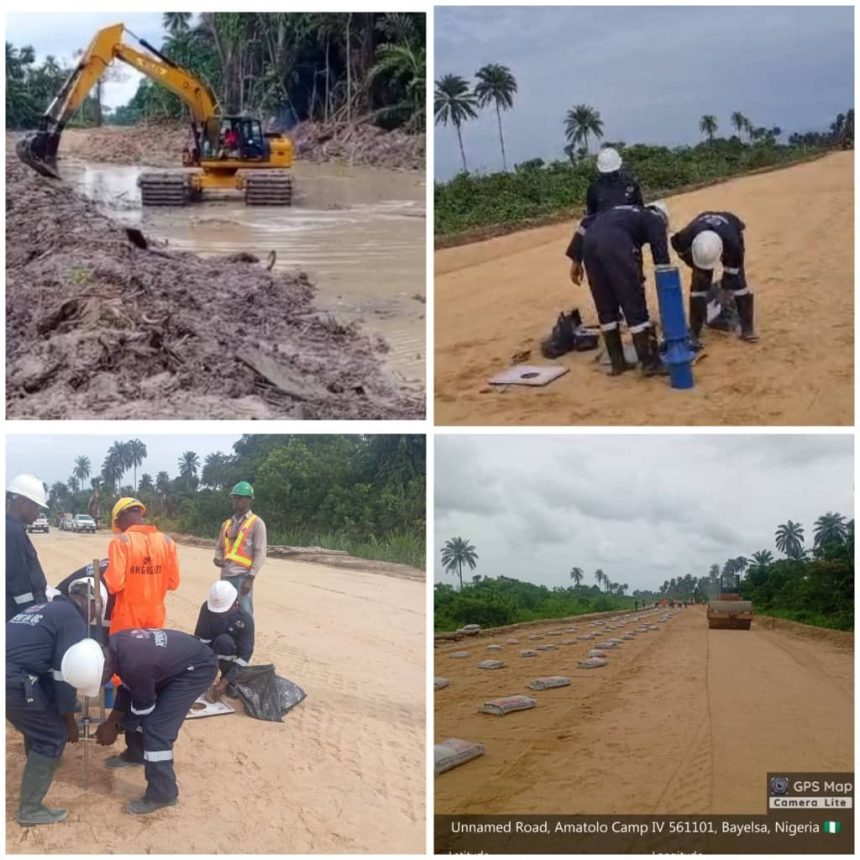
Following the award of the contract to HNG Limited, initial work progressed with site clearing and removal of topsoil extending toward Ebeni. Sand filling and dredging activities were also underway during the early phase of construction.
However, progress slowed toward the end of the administration, particularly around early 2020. This slowdown has been linked to the economic challenges facing Nigeria at the time, including a recession that affected funding for public projects.
In 2023, the current administration under Governor Douye Diri revisited the project. The contract was revalidated at a revised cost of ₦77 billion, and contractors were directed to return to the site to continue construction.
Available information suggests that only a portion of the contract sum, estimated at about ₦5 billion, has been disbursed so far. This has left a significant balance outstanding, which may be affecting the pace of work.
Despite these funding constraints, contractors are reported to have remained active on the project site. Observations from recent visits indicate that work is ongoing, although progress is gradual due to the terrain and financial limitations.
At the same time, the project has become the subject of political debate. Some actors have circulated videos and statements questioning aspects of the project’s execution and origin. These claims have been challenged by others who argue that they misrepresent the facts.
Analysts note that infrastructure projects of this scale often span multiple administrations, making it necessary to distinguish between project initiation, funding, and execution phases. They also emphasize that the awarding of a contract does not imply direct involvement of political officeholders in construction activities.
The discussion around the Toru–Ebeni Road has also drawn attention to broader infrastructure development efforts in Bayelsa State over the past decade. Several major projects, including road networks, bridges, and public facilities, have been undertaken across different administrations.
Among these are the Yenagoa–Oporoma Road, the Sagbama–Ekeremor Road, and various urban development projects in Yenagoa. Some of these projects were initiated earlier and later completed or expanded by subsequent governments.
Industry observers say such continuity reflects the long-term nature of infrastructure planning in the state. They also highlight the importance of sustained funding and coordination to ensure timely completion.
Recent site inspections conducted over two days indicate that construction teams are still working in challenging conditions within forested areas. Contractors are reportedly continuing operations while awaiting further payments from the government.
Stakeholders have called for a more measured public discussion of the project. They stress the need for accurate information and constructive engagement to support its completion.
The Toru–Ebeni Road remains a key infrastructure project with the potential to improve transportation and economic activity in the affected communities. Its progress continues to depend on funding availability and coordinated efforts among all parties involved.