

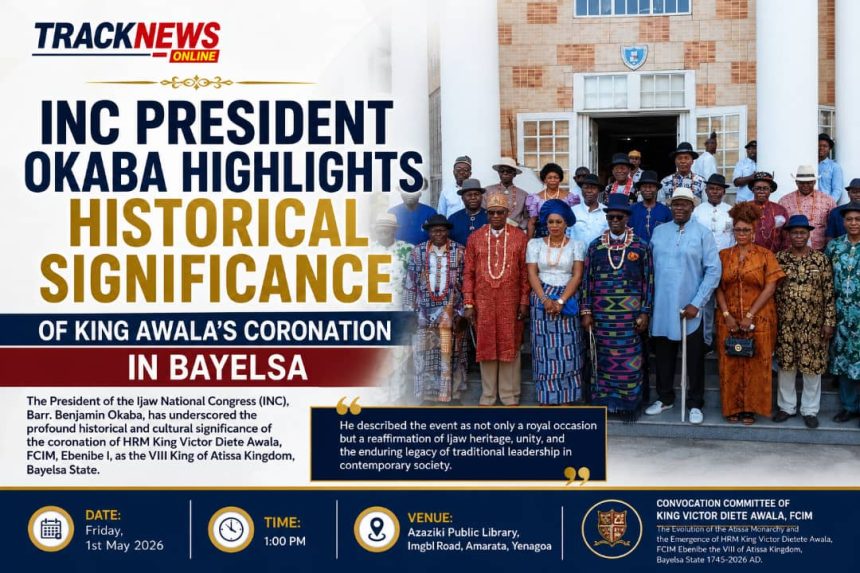
A public lecture held on May 1, 2026, at the Azikii Public Library in Amarata, Yenagoa, Bayelsa State, marked the coronation of King Victor Diemeze Awala as the Ebeni-Ibe VIII of Atissa Kingdom. The event formed part of a three-day coronation programme scheduled from May 1 to May 3, drawing traditional rulers, dignitaries, scholars, and members of the Ijaw National Congress (INC).
Chairing the occasion, the President of the Ijaw National Congress, Prof. Benjamin Okaba, described the event as a moment of deep historical and cultural significance for the Atissa Kingdom and the wider Ijaw nation. He noted that the coronation was not merely ceremonial but represented a reaffirmation of the kingdom’s enduring heritage.
The lecture, titled “The Evolution of the Atissa Monarchy and the Emergence of HRM Victor Diemeze Awala, FCIM, Ebeni-Ibe VIII of Atissa Kingdom (1745–2026 AD),” traced nearly three centuries of royal history. It highlighted the resilience of the monarchy through major historical periods, including the trans-Atlantic slave trade, colonial rule, Nigeria’s civil war, and ongoing challenges in the Niger Delta.
Prof. Okaba emphasized that the lecture underscored the importance of remembrance in royal traditions. He stated that documenting the lineage of the Ebeni-Ibe throne ensures that past rulers are not reduced to mere names but are recognized for their contributions to the kingdom’s development and identity.
The chairman also commended the choice of guest lecturer, Prof. Mark Atei Okorobia, describing him as a respected scholar in the field. He noted that the lecture provided a scholarly bridge between the past and present, offering insights into the responsibilities now placed on the new monarch.
According to him, previous rulers of Atissa Kingdom played critical roles in defending their land, resolving disputes, and preserving Ijaw cultural identity. He said such historical knowledge serves as a guide for both the new king and the people.
Prof. Okaba further stated that the lecture elevated the coronation beyond a ceremonial event to one of intellectual and cultural renewal. He noted that it demonstrated the kingdom’s commitment to preserving its history as a living source of knowledge.
He added that the documentation of King Awala’s emergence within a long historical timeline places his reign in proper context. The chairman described the new monarch as a custodian of a legacy that spans generations.
Highlighting King Awala’s professional background as a Fellow of the Chartered Institute of Management, Prof. Okaba said the monarch brings modern leadership skills to the traditional institution. He expressed optimism that this blend of tradition and professional expertise would benefit the kingdom.
The INC president commended the organisers of the lecture and called for its proceedings to be published and shared across Ijaw communities. He said such efforts would encourage other kingdoms to document their histories.
Addressing the new monarch directly, Prof. Okaba pledged the support of the Ijaw National Congress. He stressed that the progress and stability of Atissa Kingdom are closely tied to the wellbeing of the broader Ijaw nation.
He urged King Awala to lead with justice, equity, and a sense of unity, both within Atissa and among neighbouring communities. He also called for leadership that bridges traditional values with modern development needs.
Prof. Okaba concluded by expressing hope that the reign of the Ebeni-Ibe VIII would bring peace, economic growth, and infrastructural development to the kingdom. He also wished the monarch a stable and prosperous reign.
The event was attended by members of the Atissa Council of Chiefs and Elders, royal families, traditional rulers from across the Ijaw nation, clergy, industry leaders, and members of the press.