
Part One: How a disputed oil-block award, a sacked regulator and an opaque ownership structure converge around Nigeria’s Okwuibome crude
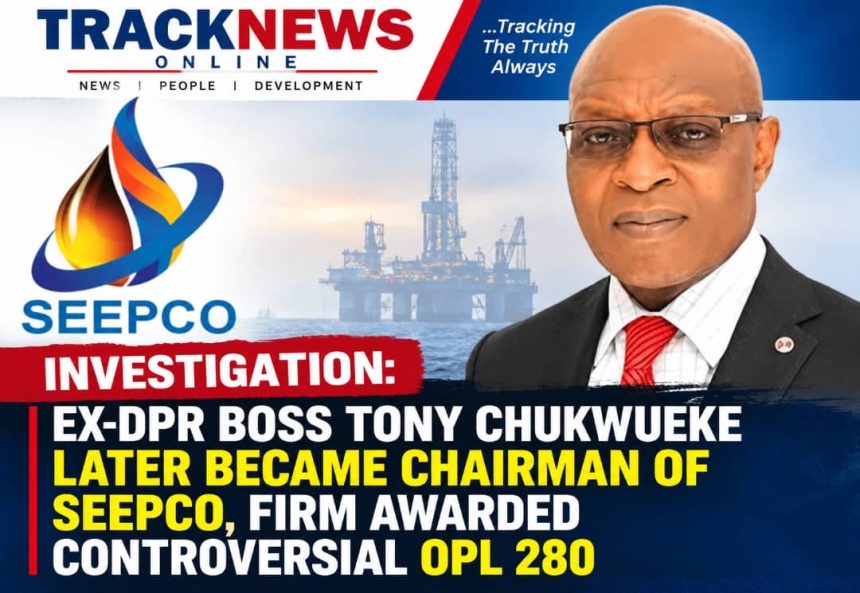
A TrackNews Online investigation has uncovered a series of questions surrounding the award and subsequent development of OPL 280, one of Nigeria’s most valuable oil assets, and the later appointment of former Department of Petroleum Resources (DPR) Director, Anthony “Tony” Chukwueke, as Chairman of Sterling Oil Exploration & Energy Production Company Limited (SEEPCO).
Chukwueke headed the DPR during a period when the agency was responsible for regulating Nigeria’s upstream petroleum industry and overseeing oil-licensing rounds.
Public records reviewed by TrackNews Online indicate that Chukwueke was removed from his position in 2007 amid concerns surrounding the issuance of petroleum licences. He was subsequently reinstated, although the circumstances surrounding both his removal and return remain insufficiently explained in the public record.
More than a decade later, in 2018, Chukwueke became Chairman of SEEPCO — the company whose acquisition of an oil asset awarded during the same broad licensing era is now at the centre of questions raised by this investigation.
The coincidence raises a fundamental question: how did a former petroleum regulator who was removed from office amid licensing concerns eventually become chairman of a company that benefited from a controversial oil-block award during the period of his stewardship?
The OPL 280 question
At the centre of the investigation is OPL 280, an asset carved from acreage formerly associated with Shell Petroleum Development Company (SPDC).
The block is associated with the Okwuibome crude stream, a low-sulphur, sweet crude grade regarded as particularly attractive to international refiners.
TrackNews Online’s findings indicate that during the 2005/2006 licensing process, SEEPCO submitted a signature-bonus offer of approximately $57 million, while the benchmark value identified in records reviewed by our reporters was substantially higher, at about $210 million.
A competing bidder was understood to have offered an amount closer to that benchmark.
SEEPCO nevertheless emerged as the successful beneficiary.
Our investigation has so far found no publicly available documentary evidence adequately explaining why SEEPCO, despite its comparatively lower offer and limited publicly documented history in petroleum exploration at the time, was preferred.
Several former DPR officials who spoke to TrackNews Online described the decision-making environment surrounding some of the awards as being influenced by instructions from senior authorities.
TrackNews Online has not independently established the identity of any official who may have issued such instructions.
From regulator to company chairman
The relationship between the licensing process and Chukwueke’s later role at SEEPCO is perhaps the most striking aspect of the investigation.
Chukwueke was at the helm of the DPR during the period in which the licensing rounds were conducted. In 2007, he was removed from office over allegations and concerns relating to improper licensing practices.
He was later reinstated.
In 2018, he assumed the chairmanship of SEEPCO.
The development creates an apparent regulatory-to-corporate overlap that deserves closer scrutiny, particularly given the history of the company’s oil assets and the licensing questions surrounding them.
TrackNews Online has found no public evidence establishing that Chukwueke personally influenced SEEPCO’s award of OPL 280. The investigation does, however, establish the chronology and raises questions that can only be conclusively answered through access to the original DPR licensing files and other official records.
The unexplained role of Allenne Energy
Another unresolved issue concerns Allenne Energy Limited (RC 653161), which appears in the ownership history associated with OPL 280.
Corporate records reviewed by TrackNews Online identify Iyabo Rotimi Adeoye, Aminat Mary Jimoh and KCU Legal among the names associated with Allenne Energy, with Babundo Omordia appearing in the relevant documentation.
Our investigation found no readily identifiable public record demonstrating significant petroleum exploration or production experience by the individuals named in the corporate records.
That raises another question:
Who was the ultimate economic interest behind Allenne Energy, and what role did the company play in the ownership and control of the oil asset?
The issue is particularly important because nominee and beneficial ownership structures can make it difficult to establish who ultimately benefits from valuable petroleum licences.
SEEPCO and the Sandesara connection
SEEPCO is part of the Sterling Biotech Group, associated with the Sandesara family of India.
Indian authorities have for years pursued members of the Sandesara family over allegations relating to a major financial fraud case.
Indian media reports have previously reported that Nitin Sandesara, Chetan Sandesara, Dipti Sandesara and Hiteshkumar Narendrabhai Patel were declared fugitive economic offenders by an Indian court.
The allegations concern financial transactions in India and are separate from the Nigerian licensing issues examined in this investigation.
The connection nevertheless becomes relevant because the ownership of SEEPCO places a valuable Nigerian crude-producing asset within a corporate group whose principal figures have faced serious legal proceedings in India.
The Okwuibome crude and the Indian court case
The investigation also examined proceedings reported in India involving Captain Sukhpal Singh and members of the Sandesara business group.
According to reports on the case, Singh sought legal orders relating to crude oil produced by SEEPCO in Nigeria, arguing that the oil represented assets connected to the Sandesara group.
Court filings reportedly alleged that between 2018 and 2020, crude shipments valued at approximately ₹5,435.43 crore — more than $1 billion at the time — were supplied by SEEPCO to Indian buyers, including Indian Oil Corporation, Bharat Petroleum Corporation and Hindustan Petroleum Corporation, through an intermediary based in the United Kingdom.
The filings further alleged that additional shipments reached Indian ports after members of the Sandesara family had already been declared fugitive economic offenders.
These allegations form part of the Indian legal proceedings and should not be interpreted as proof of wrongdoing by SEEPCO or its Nigerian operations.
Tulja Bhavani and the metering question
TrackNews Online also traced the regulatory history of SEEPCO’s crude-export infrastructure.
In October 2011, a Federal Government Gazette reportedly designated the vessel Tulja Bhavani as a floating storage and offloading facility capable of holding approximately 1.76 million barrels of crude and facilitating tanker-to-tanker transfers offshore.
The designation was made under the Oil Terminal Dues Act 1965 and was signed during the tenure of then-Minister of Petroleum Resources Diezani Alison-Madueke.
However, documents and information reviewed during our investigation raise questions about the extent to which crude volumes passing through the facility were independently metered and verified.
If confirmed, the absence of a functioning independent metering system over an extended period would raise significant questions about transparency, crude accounting, terminal dues and government revenue assurance.
SEEPCO had previously faced disqualification
The history becomes more complicated when SEEPCO’s involvement in another licensing process is considered.
In 2007, the Federal Government reversed the award of OPL 226 to SEEPCO and Essar Exploration and Production Limited after questions arose regarding their eligibility to participate in the bid process.
Available accounts indicate that the companies had not satisfied the required pre-qualification conditions and had not formally submitted bids for the blocks they were subsequently awarded.
The reversal raises a significant question about how a company that had encountered eligibility problems in one licensing process could simultaneously retain an interest in another highly valuable petroleum asset.
What the records demand
The issues identified by this investigation do not, by themselves, establish criminal wrongdoing by Chukwueke, SEEPCO, Allenne Energy or any other individual named in this report.
They do, however, raise serious questions about the transparency of Nigeria’s oil-licensing regime during the 2005–2007 period.
TrackNews Online believes that the relevant records should be subjected to an independent review, including:
– The complete DPR files relating to the award of OPL 280;
– The evaluation and scoring sheets for competing bidders;
– The basis for accepting SEEPCO’s signature-bonus offer;
– The identity of all beneficial owners associated with Allenne Energy;
– The circumstances surrounding Chukwueke’s 2007 removal and subsequent reinstatement;
– The circumstances surrounding his appointment as SEEPCO Chairman in 2018;
– The licensing history of OPL 226;
– Production and export records relating to Okwuibome crude;
– Metering and crude-accounting records connected to Tulja Bhavani; and
– Any correspondence showing whether political or ministerial directives influenced the relevant licensing decisions.
The legal questions
The investigation also raises questions about compliance with the legal and regulatory framework that governed petroleum licensing and public officers at the time.
These include provisions of the Petroleum Act 1969, the constitutional Code of Conduct for Public Officers, the Code of Conduct Bureau and Tribunal Act, the Corrupt Practices and Other Related Offences Act 2000, applicable corporate beneficial-ownership requirements, and the Oil Terminal Dues Act 1965.
However, whether any specific provision was actually breached is ultimately a matter for competent investigative and judicial authorities.
What the documents establish is a chronology that deserves examination: a regulator who was removed amid licensing concerns, a petroleum company that obtained a highly valuable asset during the same broad licensing period, a disputed bidding history, an opaque ownership trail, and the regulator’s eventual emergence as chairman of the beneficiary company.
The questions are now before the relevant Nigerian authorities.
Part Two of this investigation will examine the ownership trail behind OPL 280, the companies and individuals connected to the asset, the history of Okwuibome crude exports, and the unresolved metering and revenue questions surrounding the offshore export terminal.
TRACKNEWS ONLINE — INVESTIGATING THE RECORD.