
Stakeholders of the Open Government Partnership in Adamawa, Bauchi and Taraba states have called for stronger collaboration between government institutions and civil society organisations to deepen transparency, accountability and citizens’ participation in governance across Northeastern Nigeria.
The call was made during a webinar organised by Transparency and Accountability in Totality Initiative under its “Follow Taxes” project to assess the implementation of State Action Plans in the region.
The Open Government Partnership is a global initiative that brings together governments and civil society organisations to promote transparency, accountability, citizens’ participation and improved public service delivery. Nigeria joined the partnership in 2016, while several states, including Adamawa, Bauchi and Taraba, later adopted the initiative at the sub-national level.
The panel discussion, themed “Assessing State Action Plan Delivery in Northeastern Nigeria,” featured OGP non-state actors’ co-chairs from Adamawa, Bauchi and Taraba states who reviewed progress, challenges and implementation gaps in their respective states.
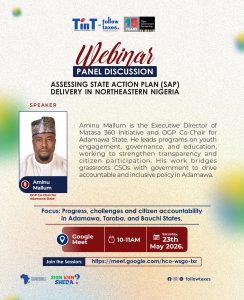
Speaking during the webinar, the Executive Director of Mata 360 Initiative and OGP Co-Chair in Adamawa State, Aminu Mallum, said the state recorded notable progress in implementing its action plans despite institutional bottlenecks and weak support from some Ministries, Departments and Agencies.
Mallum said civil society organisations played a major role in sustaining the implementation process through advocacy and partnerships with development organisations.
According to him, inadequate commitment from some government officials remained one of the major setbacks affecting implementation.
“If someone as a leader of an MDA does not have interest in implementing the activities, you can hardly achieve anything no matter how influential the people are,” he said.
He stressed the need for the establishment of a functional OGP secretariat under the Ministry of Planning to ensure continuity and better coordination of activities.
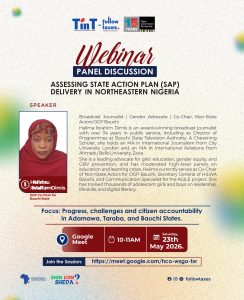
Also speaking, the Co-Chair of Non-State Actors for OGP Bauchi State, Halima Ibrahim Dimis, said the state’s first State Action Plan focused on four thematic areas including access to information, fiscal transparency, citizens’ engagement and inclusiveness in governance.
Dimis said Bauchi State had made progress in promoting public access to information and improving citizens’ participation in governance processes.
She noted that awareness around the Freedom of Information Act was increasing, while some government institutions had begun proactive disclosure of public information through official platforms.
“The citizens are now becoming more aware of their right to information, and government institutions are beginning to proactively disclose public information,” she said.
She added that the state had introduced community charter demand processes that allow residents to contribute to budget planning and monitor projects within their communities.
Dimis further disclosed that stakeholders were developing a digital platform known as “OGP Project Track” to improve project monitoring and accountability in the state.
While identifying knowledge gaps and poor understanding of OGP principles as key challenges, she clarified that the initiative was designed to support governance reforms rather than witch-hunt public officials.
“OGP is not a police institution; it is an enabler that encourages transparency, accountability and citizens’ participation in governance,” she stated.
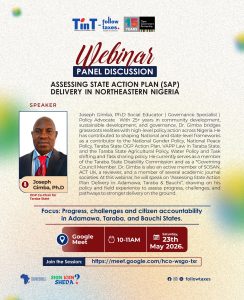
On his part, governance specialist and policy advocate, Dr Joseph Gimba, said Taraba State’s OGP implementation journey had faced serious setbacks due to weak institutional structures and leadership changes.
Gimba explained that efforts to domesticate OGP in Taraba began years before the state formally joined the partnership in 2021 with support from civil society groups and development partners including Oxfam.
According to him, implementation of the state’s action plan slowed after changes in government leadership disrupted coordination efforts.
“After the planning stage, the co-chair was removed and the momentum slowed down. Taraba State OGP virtually went to sleep,” he said.
Despite the challenges, he said civil society groups in the state continued engaging citizens through budget consultations and community participation initiatives.
Gimba, however, expressed concern over what he described as weak technical capacity among some civil society organisations and government actors involved in the OGP process.
“We lack the competence, patience and understanding to fully engage with the technical processes of OGP,” he said.
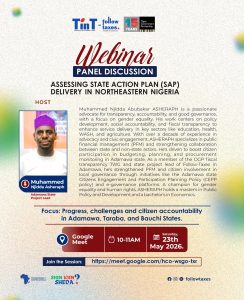
Earlier in his remarks, the webinar host and Adamawa State Project Lead of Follow Taxes, Muhammed Njidda Asheraph, commended stakeholders for their commitment to strengthening open governance in the Northeast.
He expressed optimism that the discussions and recommendations from the webinar would contribute to improving transparency, accountability and effective service delivery across the region.