
President cites $55bn external reserves, over $6bn in non-oil exports; Soludo calls for double-digit economic growth and increased investment.
President Bola Ahmed Tinubu has declared that the economic reforms introduced by his administration are beginning to yield positive results, expressing optimism that Nigeria is moving towards an era of shared prosperity.
The President said the difficult economic decisions taken since he assumed office on May 29, 2023, had started producing measurable outcomes, including an increase in the nation’s external reserves to approximately $55 billion, non-oil exports exceeding $6 billion and significant improvements in government revenue.
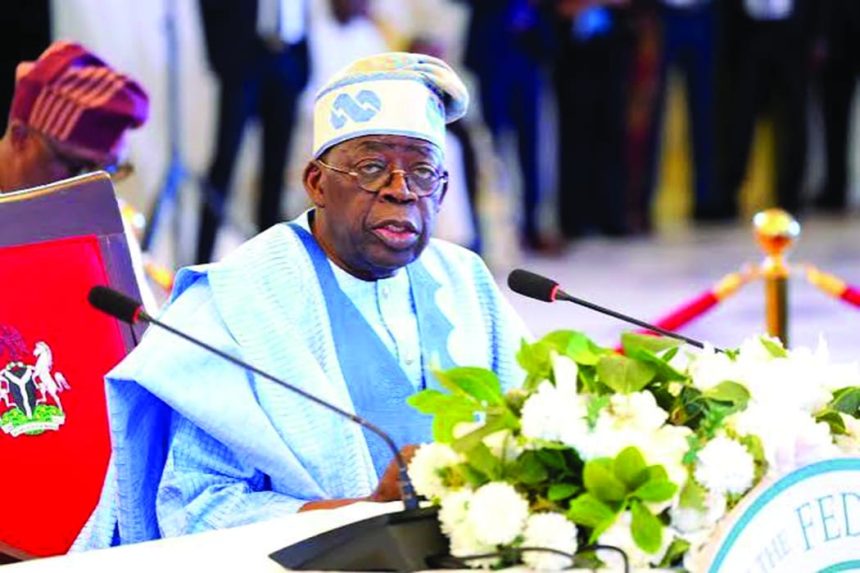
Tinubu spoke on Thursday at the presentation of a book titled Economic Diversification and Structural Transformation in Nigeria: The Past, The Present, The Future, authored by a member of the House of Representatives, Hon. Abdulmumini Jibrin Kofa, at the State House Conference Centre, Abuja.
The President, who was represented by the Speaker of the House of Representatives, Hon. Tajudeen Abbas, said his administration was shifting attention from economic stabilisation to translating improved economic indicators into tangible benefits for Nigerians.
He identified employment opportunities, affordable housing, improved electricity supply and increased domestic production as key priorities in the next phase of the government’s economic programme.
Tinubu, who wrote the foreword to the book, said the Federal Government had laid the foundation for a more productive and diversified economy, with a target of building a $1 trillion economy by 2030.
According to him, non-oil activities now account for approximately 96 per cent of Nigeria’s Gross Domestic Product, while non-oil exports have exceeded $6 billion.
He also disclosed that external reserves had risen to about $55 billion, representing more than 14 months of import cover.
The President further stated that non-oil revenue increased from N13.63 trillion in 2023 to N16.4 trillion in the first half of 2026.
“Our task has moved from stabilisation to shared prosperity, and our compass points firmly to a $1 trillion economy by 2030, charted in the Medium-Term National Development Plan 2026–2030,” he said.
Reflecting on the economic challenges inherited by his administration, Tinubu said Nigeria was facing fiscal difficulties, currency instability, mounting debt obligations, declining industrial productivity and depleted foreign reserves.
He identified the removal of the petrol subsidy and the unification of the foreign exchange market as difficult but necessary decisions aimed at preventing a deeper economic crisis.
According to him, previous governments allowed the nation’s economy to depend excessively on petroleum revenue, leaving government finances, businesses and households vulnerable to fluctuations in international oil prices.
Tinubu maintained that his administration had to choose between maintaining unsustainable economic policies and implementing far-reaching reforms to restore fiscal stability.
He acknowledged, however, that improved economic statistics alone would not be enough to satisfy Nigerians, stressing that the ultimate measure of the reforms would be their impact on ordinary citizens.
“The nation is not lifted by statistics alone. Numbers must become bread on the table, light in the home, and hope for willing arms,” he said.
On electricity, the President described inadequate power supply as one of the major obstacles to Nigeria’s industrial development.
He assured Nigerians that his administration was pursuing significant investments to improve electricity generation and transmission capacity.
Tinubu also highlighted the Federal Government’s reported victory in the $3.38 billion international arbitration dispute concerning the Mambilla Hydroelectric Power Project, describing it as an important development in efforts to revive the long-delayed project.
Soludo Calls for Double-Digit Growth
Meanwhile, Anambra State Governor, Professor Chukwuma Soludo, has warned that Nigeria’s ambition of building a $1 trillion economy by 2030 would remain difficult to achieve without double-digit economic growth and substantial increases in public and private-sector investments.
Soludo acknowledged that the Tinubu administration had taken steps to stabilise the economy but argued that the current growth rate of approximately four per cent was insufficient to drive rapid industrialisation, significantly reduce poverty and create enough employment opportunities for the country’s growing population.
He called for a more aggressive economic transformation strategy supported by investments exceeding 30 per cent of GDP, sustained industrialisation, competitive exchange-rate policies and continuity of economic reforms beyond electoral cycles.
Delivering a keynote address titled Speeding Up and Building to Last, the Anambra governor argued that Nigeria had lost considerable time in its economic development journey and must now pursue structural transformation with greater urgency.
He stressed that achieving the country’s $1 trillion economic ambition would require sustained investment, stronger industrial capacity and policies capable of supporting long-term economic growth.