

What appeared to be an ordinary three-bedroom apartment tucked away in the Ilado area of Olorunda Local Council Development Area was, in reality, the centre of an alleged fraudulent academic and recruitment scheme that lured over 100 young people from across Nigeria and neighbouring West African countries into Badagry with promises of foreign university admission.
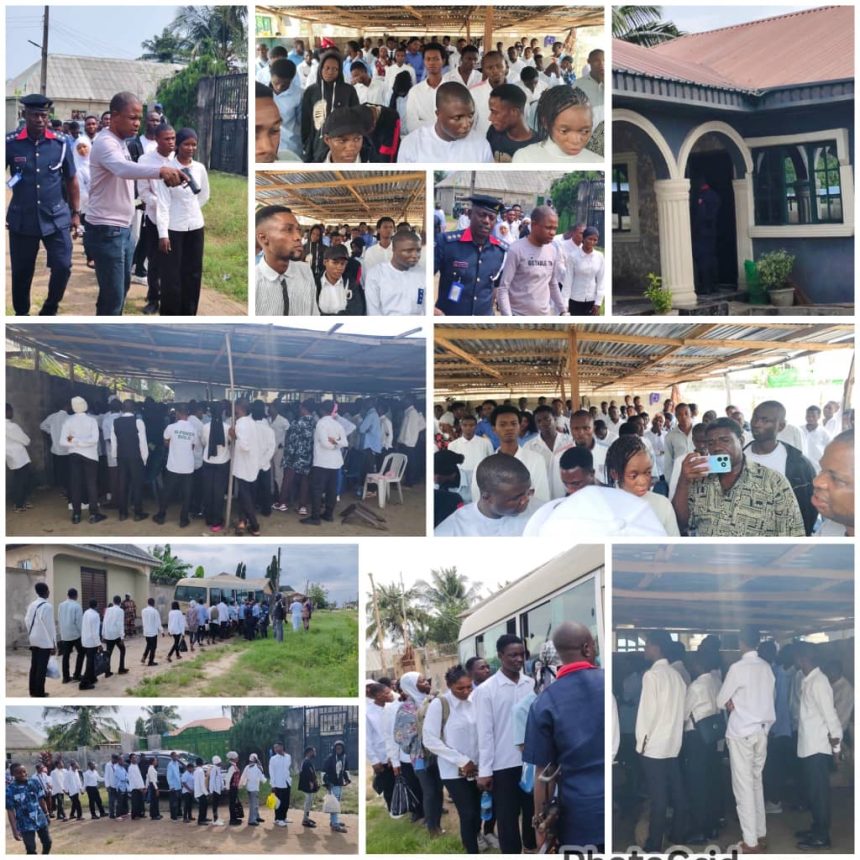
The Nigeria Security and Civil Defence Corps (NSCDC), Badagry Area Command, confirmed to Badagry Today that it has dismantled the operation and taken 106 young persons into protective custody, while arresting the alleged proprietor of the illegal institution.
The dramatic operation was carried out in the early hours of Monday after days of intelligence gathering and covert surveillance by NSCDC operatives.
When Badagry Today visited the scene shortly after the raid, the apartment was filled with young men and women, many of them visibly confused and uncertain about what lay ahead. Most of those found inside are between the ages of 19 and 24.
Further findings by Badagry Today revealed that the victims came from different parts of Nigeria, including Kogi, Oyo and several northern states, while others travelled from neighbouring countries such as Niger, Cameroon and Togo after being recruited online.
Even more disturbing was the discovery that the so-called university had no official name, no signboard, no registration and no known campus. It allegedly operated entirely from the rented apartment while presenting itself online as a distance learning centre affiliated with a foreign university.
Speaking exclusively with Badagry Today, the Badagry Area Commander of the NSCDC, Chief Superintendent Gbenga Ekunola, disclosed that the operation followed credible intelligence received by the command.
“We got reliable intelligence about the activities going on there. Our officers monitored the place for days before moving in. We have arrested the proprietor, who is assisting with our investigation, while the students have been taken into our protective custody,” he said.
According to preliminary investigations, unsuspecting young people were allegedly convinced that they had secured admission into a foreign tertiary institution after making payments described as admission and processing fees.
Victims said they paid different amounts ranging from ₦200,000 to ₦1.5 million, while some foreign nationals and citizens said they paid $400 to $500 US dollars.
However, the admission offer allegedly came with another condition.
The operators reportedly encouraged students to recruit more people into the programme, promising commissions for every successful referral.
The recruitment model allegedly worked like a chain marketing or Ponzi scheme, where participants earned increasing financial rewards based on the number of new students they introduced.
One of the victims admitted that after paying $400 US dollars, he convinced his own brother in Kogi State to enrol and had already begun earning commissions from the referrals.
The NSCDC investigators also uncovered another layer of the operation, with some of the students allegedly engaged in promoting unidentified products online while receiving percentages from sales and recruitment.
Chief Superintendent Ekunola expressed concern that many parents had no idea what their children were actually doing in Badagry.
“We have started contacting their families. One parent told us her child informed the family that he came to Badagry to learn a trade, not to attend a university. That shows many of these parents were completely unaware,” he said.
He assured Badagry Today that the command would profile every victim and work towards reuniting them with their parents and guardians after investigations.
He also vowed that everyone found culpable in operating the alleged fake institution would face prosecution in accordance with the law.
The discovery has once again exposed the growing danger of fraudulent online admission schemes targeting desperate young people seeking educational opportunities outside the country.
As investigations continue, security authorities are working to determine the full extent of the network, identify other collaborators and establish whether similar operations are running in other parts of Nigeria.
For many of the young people rescued in Ilado, what they believed would be the beginning of an international academic journey has instead ended inside an apartment now at the centre of a major criminal investigation.