
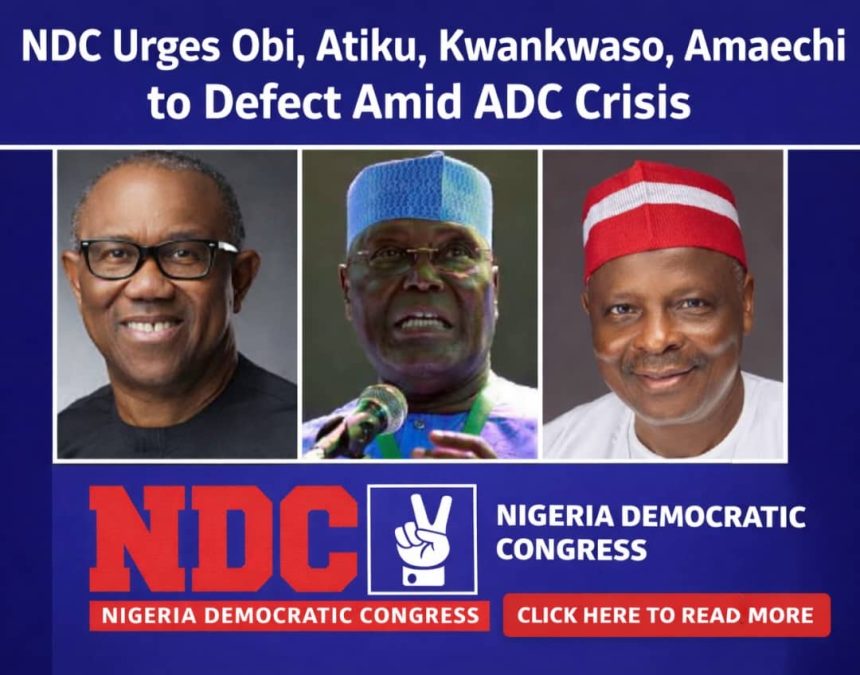
The National Democratic Coalition (NDC) has reportedly extended an invitation to prominent Nigerian political figures, including Peter Obi, Atiku Abubakar, Rabiu Kwankwaso, and Rotimi Amaechi, to join its platform as opposition realignments intensify ahead of future elections.
The move comes amid reports of internal disputes within the African Democratic Congress (ADC), which some analysts say could weaken opposition coordination against the ruling All Progressives Congress (APC).
According to sources familiar with the development, the NDC’s appeal is part of a broader effort to consolidate opposition strength under a unified front. The coalition is said to be positioning itself as a viable alternative capable of challenging the APC’s dominance, particularly by attracting influential politicians with established national followings.
The reported invitation targets key figures who have previously contested or held significant political influence across different regions. Peter Obi, the Labour Party’s 2023 presidential candidate, retains strong youth support and a reform-focused image. Atiku Abubakar, a former vice president and multiple-time presidential contender under the Peoples Democratic Party (PDP), continues to command a large political network.
Rabiu Kwankwaso, leader of the Kwankwasiyya movement and former Kano State governor, is also seen as a crucial northern political force. Rotimi Amaechi, a former minister of transportation and ex-governor of Rivers State, adds further weight due to his experience within the APC and his national visibility.
The NDC’s outreach comes at a time when the ADC is reportedly grappling with internal disagreements over leadership and strategic direction. While details of the crisis remain unclear, political observers suggest that factional disputes and organizational challenges may be limiting the party’s ability to function effectively as a unifying opposition platform.
Some analysts believe the NDC is attempting to capitalize on this uncertainty by presenting itself as a more stable and cohesive alternative. By inviting high-profile politicians, the coalition may be seeking to build momentum and credibility ahead of future electoral cycles.
There has been no official confirmation from the invited politicians regarding whether they will consider the NDC’s proposal. However, past political realignments in Nigeria have shown that shifting alliances are common, particularly when parties face internal crises or diminished electoral prospects.
Political commentators note that any potential defection or alliance involving these figures could significantly reshape Nigeria’s political landscape. The inclusion of leaders with diverse regional bases could enhance the opposition’s chances of mounting a stronger challenge to the APC in subsequent elections.
At the same time, questions remain about the NDC’s organizational structure, leadership, and ability to accommodate multiple high-profile figures without internal conflict. Building a unified coalition among politicians with differing ideologies and ambitions has historically proven difficult in Nigerian politics.
The APC has not publicly responded to the reported invitation, but the ruling party has previously expressed confidence in its political strength and organizational capacity. Observers say the APC will likely monitor opposition movements closely as preparations for future contests begin to take shape.
As the situation develops, the focus will remain on whether the NDC can translate its outreach into concrete political alliances. The response of Obi, Atiku, Kwankwaso, and Amaechi will be critical in determining whether the coalition’s efforts mark the beginning of a broader opposition realignment or remain an unfulfilled initiative.