
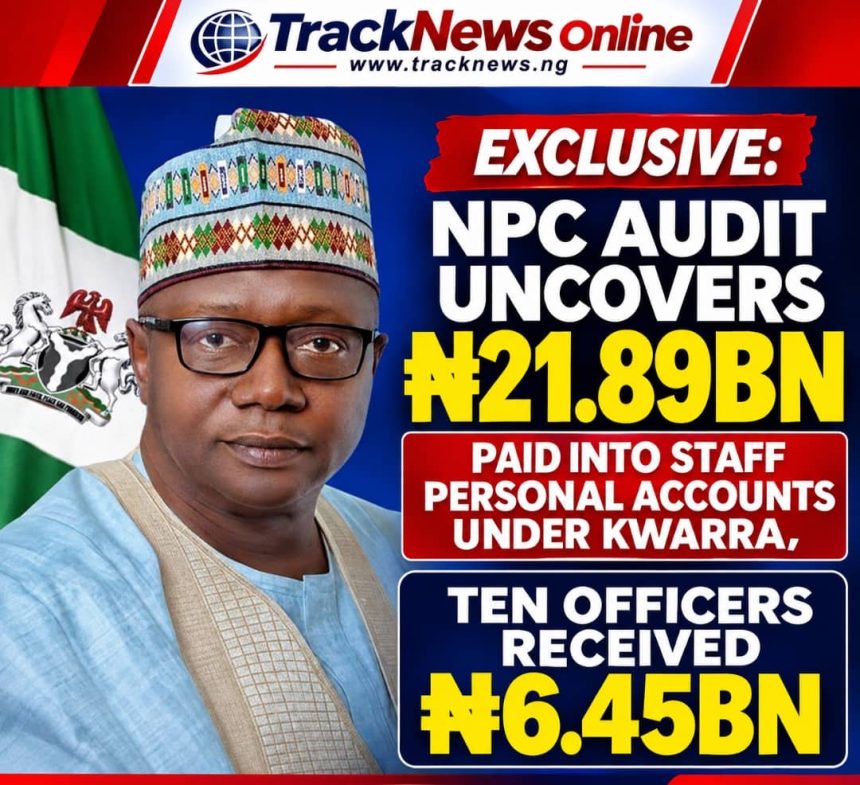
An official audit report on the National Population Commission (NPC) has uncovered payments totalling ₦21,891,592,106.88 into the personal bank accounts of the Commission’s staff, rather than directly to the actual beneficiaries and service providers for whom the public funds were intended.
The audit document, examined by TrackNews, further reveals that ten staff members alone received a combined ₦6,452,748,352.42, with individual payments running into hundreds of millions of naira.
The audit classified the transactions as a serious violation of Federal Government e-payment procedures and non-compliance with financial regulations governing the procurement of goods and services above the ₦200,000 threshold.
The findings cover payments recorded between January 1, 2020, and the period examined by the auditors, spanning the tenure of former NPC Chairman, Nasir Isa Kwarra, who led the Commission from October 28, 2020, to October 28, 2025.
Although the audit period began about ten months before Kwarra assumed office, the records document substantial transactions during his chairmanship, including a single-day payment of ₦1.63 billion into staff accounts in April 2023.
BILLIONS PAID THROUGH STAFF ACCOUNTS
According to the audit report, the payments were processed in tranches ranging from ₦4 million to ₦74 million and covered several activities and services that ordinarily should have been paid directly to contractors and actual beneficiaries.
The expenditures included staff training, rental and furnishing of office accommodation, newspaper advertisements, vectorisation of buildings and road projects, advances and honoraria for Integrated Census Rehearsal (ICR) training, zonal training for the 2023 Population and Housing Census, hall rentals, feeding allowances and media breakfast meetings organised at state level.
However, the auditors questioned why money meant for these services was transferred into the personal bank accounts of Commission employees instead of the accounts of the actual suppliers and service providers.
The report specifically stated that the practice violated government financial procedures, bypassed proper contracting arrangements and potentially deprived the Federal Government of taxes that should have been remitted through legitimate procurement transactions.
FINANCIAL REGULATIONS CITED
The audit report referenced Financial Regulation 613 of 2009, which provides that payments should only be made to actual beneficiaries.
It also cited Financial Regulation 417, which requires public expenditure to be properly classified and applied strictly to the purposes for which funds were appropriated.
Under the provisions, expenditures wrongly charged to a particular vote are liable to be disallowed.
The report further raised questions about compliance with the Public Procurement Act, particularly the requirement for appropriate procurement processes in the engagement of contractors and service providers.
The Federal Government’s e-payment framework is designed to ensure that public funds are transferred electronically and directly to the persons or organisations entitled to receive them, thereby establishing a verifiable financial trail.
By routing payments through employees’ personal accounts, the Commission’s transactions created an accountability concern, as the staff members appeared as recipients in the banking records rather than the actual vendors or beneficiaries of the expenditure.
₦1.63BN PAID TO STAFF IN ONE DAY
One of the most significant transactions identified in the audit occurred on April 12, 2023.
On that day alone, the Commission reportedly transferred ₦1,637,502,400 into various staff accounts for newspaper advertisements, accommodation and furnishing, advocacy and publicity.
The auditors specifically identified the transaction as a violation of established e-payment procedures.
The timing is particularly significant because the payment occurred during preparations for the 2023 Population and Housing Census, which was subsequently postponed on April 29, 2023, seventeen days after the transaction.
The audit findings raise questions about the Commission’s financial management and internal controls during preparations for the national census.
TEN STAFF WHO RECEIVED ₦6.45BN
The audit document identified ten staff members who received the largest cumulative payments, with their combined receipts amounting to ₦6,452,748,352.42.
The individuals and the amounts recorded against their names are:
1. Maduabuchi Ogonnaya Derek – ₦963,058,178.46 (UBA).
2. Ogohi Abu – ₦809,350,652.57 (UBA).
3. Osundare Ibrahim Tunde – ₦767,009,029.43 (GTBank).
4. Mohammed Abdulrahman – ₦705,531,723.59 (UBA).
5. Abdulrrahman Azeez – ₦650,853,533.00 (Ecobank).
6. Adeniyi Busayo Comfort – ₦643,665,985.37 (Zenith Bank).
7. Adegunwa Florence Enimienlen – ₦604,914,130.00 (First Bank).
8. Badejo Bidemi Adetutu – ₦506,105,950.00 (GTBank).
9. Makama Ali Yahuza – ₦475,741,000.00 (UBA).
10. Okafor Rosemary Ijeoma – ₦326,518,170.00 (Zenith Bank).
The figures, as contained in the audit document, show that the first three staff members alone received a combined ₦2,539,417,860.46.
The smallest amount among the ten largest recipients was ₦326.5 million, while the largest was ₦963 million.
These figures represent cumulative payments recorded against the individual staff members, rather than evidence that the entire amounts were personally retained by them. The audit’s central concern is that public funds meant for goods and services were channelled through employees’ personal bank accounts instead of being paid directly to the actual beneficiaries.
AUDIT WARNS OF POSSIBLE DIVERSION OF PUBLIC FUNDS
In its risk assessment, the audit report identified the possibility of diversion of public funds as a major risk associated with the payment arrangement.
The auditors recommended that the Commission provide a satisfactory explanation for the violation of existing laws and regulations governing public expenditure.
The document also stated that a detailed payment report was attached to support the findings.
The revelations raise serious questions about the internal financial controls of the National Population Commission, the role of its management during the period under review, and the effectiveness of oversight mechanisms designed to protect public funds.
TrackNews notes that the audit period predates Kwarra’s appointment and therefore does not establish that he personally authorised or directed every transaction documented in the report. However, the inclusion of substantial payments during his five-year tenure raises questions about the Commission’s financial oversight and accountability under his leadership.
The Commission’s management, the named staff members and former leadership are entitled to respond to the findings and clarify the circumstances surrounding the transactions.
TRACKNEWS ONLINE
Investigating the records. Demanding accountability.