

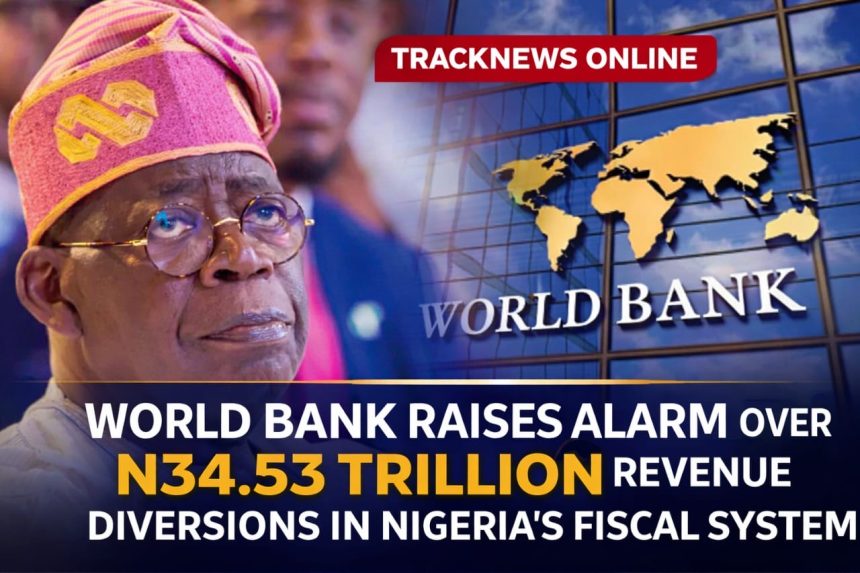
The World Bank has expressed concern over Nigeria’s fiscal structure, revealing that more than N34.53 trillion in government revenue was diverted through pre-distribution deductions between 2023 and 2025. The funds, according to the institution, were withheld before reaching the Federation Account, where revenues are typically shared among federal, state, and local governments.
In its latest Nigeria Development Update, the World Bank reported that total federation revenue rose significantly to about N84 trillion during the three-year period. Despite this increase, roughly 41 percent of the total earnings never made it into the distributable pool due to what it described as “first-line charges.”
The report showed that gross revenue grew from N17.08 trillion in 2023 to an estimated N37.44 trillion in 2025. However, deductions also surged within the same period, rising from N6.22 trillion to nearly N15 trillion. This trend significantly reduced the funds available for allocation across different tiers of government.
According to the World Bank, the situation has created a contradiction in Nigeria’s public finance system. While revenues have increased on paper, actual government spending capacity has not improved proportionately. A substantial share of income is automatically retained by certain agencies before the remaining funds are distributed.
The institution attributed part of the revenue growth to economic reforms such as the removal of petrol subsidies and adjustments in the foreign exchange market. These measures boosted nominal revenue figures but did not translate into stronger fiscal outcomes due to the structure of pre-distribution deductions.
Key agencies involved in these deductions include the Nigeria Customs Service, the Nigerian National Petroleum Company Limited, and the Federal Inland Revenue Service. The World Bank noted that these entities receive funding based on fixed percentages of gross revenue, meaning their allocations increase as revenues rise.
This arrangement, the report stated, creates a “pro-cyclical” system in which agency funding grows automatically without being subjected to standard budgetary scrutiny. As a result, the process operates outside the conventional appropriation framework and weakens legislative oversight.
The report further highlighted that in some instances, the allocations received by individual agencies exceed the total revenues of several Nigerian states. In other cases, they surpass the budgets of key federal ministries, raising concerns about balance and accountability in public finance management.
Beyond revenue allocation, the World Bank also pointed to the broader fiscal impact of the system. It noted that Nigeria’s capital expenditure declined from N5.5 trillion in 2024 to N4.5 trillion in 2025. Only about a quarter of the approved capital budget was implemented during this period, reflecting constraints on government spending.
At the same time, the federal fiscal deficit remained high at N16.9 trillion. The deficit was driven largely by debt servicing obligations and recurrent expenditure, which continue to consume a significant portion of available resources.
The World Bank warned that the current framework undermines fiscal transparency and accountability. With large amounts of public revenue being spent outside the formal budgetary process, it becomes more difficult to track expenditures and ensure efficient use of funds.
The institution emphasized the need for reforms to improve oversight and align revenue management with established budgetary practices. Without such changes, it cautioned that Nigeria may continue to face challenges in translating revenue gains into meaningful public investment and economic development.