
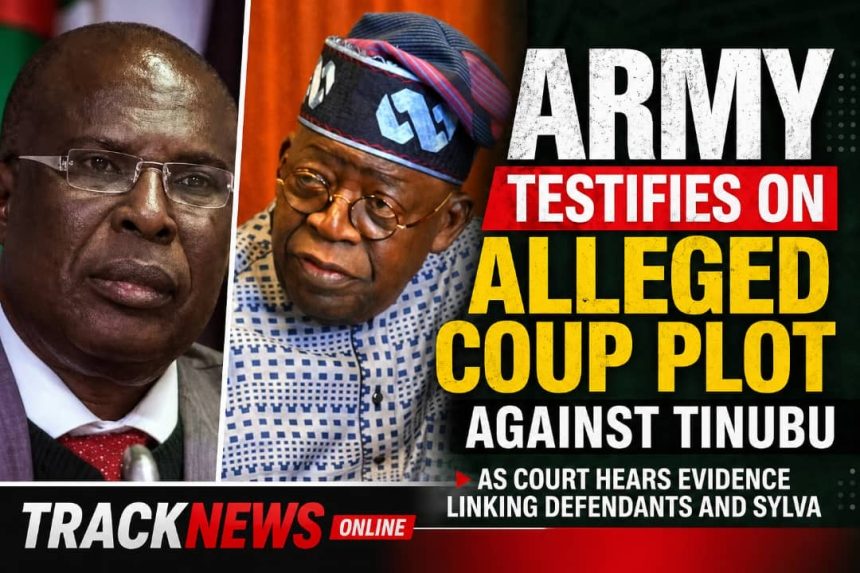
The Nigerian Army has told the Federal High Court in Abuja that it uncovered a detailed plot to overthrow President Bola Tinubu’s administration, as proceedings continued in the trial of six individuals accused of masterminding a coup.
Testifying on Wednesday, a protected witness from the Nigerian Army Corps of Military Police said the investigation began after intelligence was received by the then Chief of Army Staff, Lt. Gen. O. O. Oluyede. The report indicated that Colonel Mohammed Alhassan Ma’aji and others were planning to topple the democratically elected government.
The witness, identified only as “AAA,” said the intelligence was carefully analyzed and deemed credible before a full investigation was ordered. He told the court that the six defendants were arrested due to their alleged connections to the plot involving both military personnel and civilians.
Those on trial include retired Major General Mohammed Ibrahim Gana, retired Naval Captain Erasmus Ochegobia Victor, Police Inspector Ahmed Ibrahim, and three civilians—Zekeri Umoru, Bukar Kashim Goni, and Abdulkadir Sani. Former Bayelsa State Governor Timipre Sylva was also named in the charge but is reportedly at large.
According to the witness, investigators arrested Col. Ma’aji and recovered a Samsung Galaxy phone and a handwritten notebook from him. The notebook allegedly contained operational plans, names of key government officials, and details of individuals marked for assassination during the planned coup.
He further stated that the document outlined structural and political changes intended to follow a successful takeover. Forensic analysis of the recovered phone reportedly revealed communications and plans linking the defendants and other collaborators.
The court heard that financial records also played a key role in the investigation. The witness said there were financial trails connecting Col. Ma’aji, some of the defendants, and former Governor Sylva. Funds were allegedly distributed to support the coup effort.
Investigators also examined transactions linked to a company identified as Purple Wave, which was described as a conduit for financing the operation. Records provided by the Economic and Financial Crimes Commission showed multiple large withdrawals between September and October 2025.
The transactions included repeated debits of between N50 million and N100 million, alongside other amounts such as N80 million, N70 million, and N90 million. Although the payments were labeled for various purposes, the witness said investigators concluded they were used to fund the alleged plot.
One such transaction, described as payment for clearing debris along a coastal corridor, was said to have been diverted for the coup activities. The witness maintained that the financial evidence established a pattern of funding tied to the conspiracy.
The court was also told that several meetings were held in Abuja locations including Green Land Apartment and BrookVille Hotel. During these meetings, participants allegedly discussed regime change and planned attacks on strategic targets.
Among the identified targets were military facilities, including the Niger Barracks, as well as major roads and infrastructure. The plotters were also said to have assigned roles among themselves and discussed post-coup government structures.
The witness added that vehicles were procured and modified for operational use, while receipts and booking records from hotels were recovered to support claims of secret meetings. Some of these documents were admitted into evidence despite objections from defense counsel.
A flash drive containing recorded statements from the defendants was also presented in court, though its admissibility was contested. The judge ordered that the defense be given access to the material before it could be played in open court.
Earlier, the court approved a request by the Federal Government to shield the identities of certain witnesses, citing security concerns. Justice Joyce Abdulmalik ruled that the sensitive nature of the case justified protective measures, including withholding personal details from public records.
Defense lawyers argued that complete anonymity could undermine the defendants’ right to a fair trial, but the court maintained that the law allows such protections where necessary.
The defendants face a 13-count charge that includes treason, terrorism, and money laundering. Prosecutors allege they conspired in September 2025 to wage war against the state and failed to report knowledge of the planned coup.
All six defendants pleaded not guilty when arraigned on April 22 and remain in the custody of the Department of State Services. The case has been adjourned until May 4 and 5 for further hearing.