
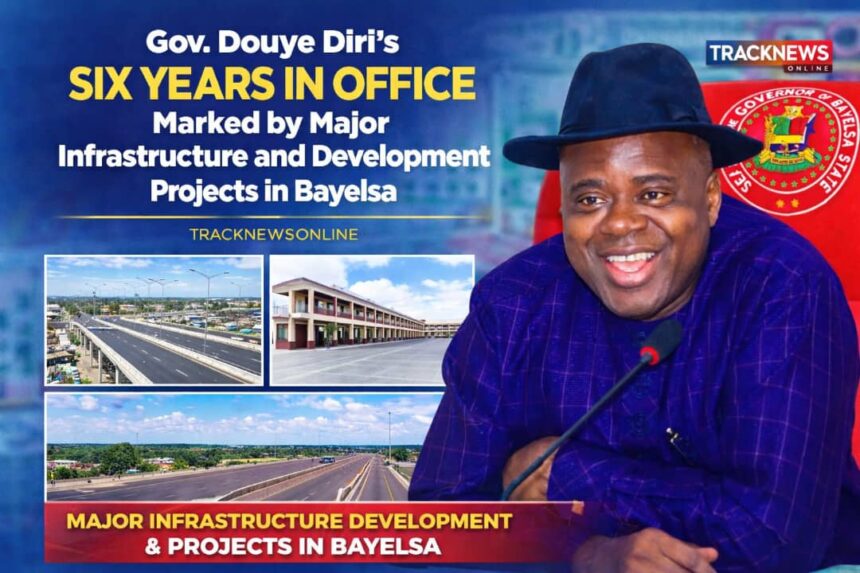
Bayelsa State Governor Douye Diri has initiated and completed numerous infrastructure and development projects across the state during his six years in office, with a focus on road construction, housing, public buildings, healthcare, education, and community development.
Many of the projects were carried out under the administration’s Prosperity agenda and are spread across the state’s three senatorial districts. The projects include major road networks linking riverine communities, new government buildings, housing schemes, educational facilities, and healthcare infrastructure.
Road construction has been one of the most significant aspects of the administration’s development drive. Among the key projects is the 22.2-kilometre Yenagoa–Oporoma–Ukubie Road, designed to improve access between communities in Southern Ijaw and other parts of the state.
Other major road projects include the Angiama–Oporoma Road, Angiama–Otuan Road, and the Angiama–Eniwari–Fonibiri Road. The government also initiated the 42-kilometre Sagbama–Ekeremor Road, which aims to enhance connectivity between the Sagbama and Ekeremor local government areas.
Work has also progressed on the Ekeremor–Agge Road, with the first phase reaching Toru-Ndoro and Peretorugbene. The 21-kilometre Nembe–Brass Road project also began during the period, with the first phase currently underway.
In Yenagoa, the state capital, several urban road projects have been completed or upgraded. These include Glory Drive Phase II, which spans about 10.8 kilometres, and Glory Drive Phase III, covering 7.8 kilometres.
The government also redesigned and expanded the Etegwe–Edepie Roundabout to improve traffic flow and urban aesthetics. The Isaac Boro Expressway was also completed during the period.
Other notable projects include the 6.5-kilometre Igbedi Road and its extension, as well as the 21-kilometre Igbogene–AIT/Elebele Outer Ring Road. These projects are expected to ease transportation within the capital city and surrounding communities.
The administration also undertook a number of bridge reconstruction projects. These include the Yenagoa–Elebele bridges reconstruction, Elebele Community Bridge reconstruction, and completion of the Imiringi Community Bridge.
Additional road rehabilitation and reconstruction works were carried out on Imiringi Road and the Onuebum–Otueke Road. The Akaba–Ogu–Okodi Road project and the Nembe Unity Bridge were also completed.
Other infrastructure developments include the Ox-Bow Lake–Agbura Road and the Polaku–Sabagriea Road and bridge project. The 18.7-kilometre Agbere–Abuetor–Osifo–Osekwenike–Asamabiri–Ekperiwari–Elemebiri road project also forms part of the state’s expanding road network.
The government also worked on roads linking Okumbiri–Eriama–Kunu–Adagbabiri and Ogbosuware–Egbema–Angalabiri. In addition, the Sampou Community Entrance Road was dualised to improve access into the community.
Housing and public buildings have also received considerable attention. One of the flagship projects is the iconic nine-storey state secretariat building in Yenagoa, which is expected to house several government ministries and departments.
The Ernest Ikoli Media Complex was constructed to provide improved facilities for the media industry in the state. The Bayelsa Health Insurance Scheme administrative complex was also built as part of efforts to strengthen healthcare management.
The state government remodelled and completed the Bayelsa Transport Terminal, while new judges’ quarters were built in Yenagoa. A new High Court complex named after Justice Ungbunku was reconstructed at Onopa.
Other public facilities include renovated courtrooms and the unveiling of a new Lady Justice statue at the Ovom court premises. New commissioners’ quarters and legislative quarters were also constructed, along with landscaping works at the housing facilities.
The administration completed civil servants’ housing units at Okaka and also built a civil servants’ canteen within the Secretariat Complex in Ovom, Yenagoa.
The permanent orientation camp of the National Youth Service Corps at Boro Town in Kaiama was completed, including new hostel facilities for corps members.
Other government buildings include the Finance House in Yenagoa and the Labour House for the Nigeria Labour Congress and Trade Union Congress.
Community development projects were also implemented across several local government areas. Town halls and pavilions were built in communities such as Peretorugbene and Ekeremor in Ekeremor Local Government Area.
Additional pavilions were constructed in Ofoni in Sagbama Local Government Area, Oruma in Ogbia Local Government Area, and Odi, Kaiama, Sampou, and Igbedi in Kolokuma/Opokuma Local Government Area.
In the education sector, the administration established six new secondary schools located in Obogoro, Ovom, Yenizue-Epie, Biogbolo, Akenfa, and Igbogene.
Four science, technical, and vocational colleges were also built in Swali, Sampou, Ofoni, and Ayamasa to expand technical education and skills training opportunities.
Healthcare development has also been part of the government’s infrastructure drive. The state built a new Haemo Dialysis Centre in Yenagoa and established a referral hospital in Oporoma.
A molecular laboratory was also constructed in Yenagoa to strengthen diagnostic capacity. The government additionally built a community school of midwifery in Sampou and a Mother and Child Hospital in Azikoro in collaboration with the Sustainable Development Goals office in Abuja.
The administration also launched the “Operation Light-Up Bayelsa” initiative, which involves the installation of solar-powered streetlights in several communities and along major roads.
In addition to large infrastructure projects, the government constructed over 70 internal roads within Yenagoa and more than 100 concrete roads in communities across the state’s eight local government areas.
Several projects were both initiated and completed within the same administration. These include the Ernest Ikoli Media Complex, the New Finance House, Glory Drive Phase II, the Igbogene–AIT/Elebele Outer Ring Road, and the expansion and beautification of the Etegwe–Edepie Roundabout.
Other completed projects include the Aguobiri Bridge, the 630-metre Angiama–Oporoma Bridge, and multiple dualised roads in the New Yenagoa City development area.
Together, these projects represent one of the most extensive infrastructure development efforts undertaken by the Bayelsa State Government in recent years.