
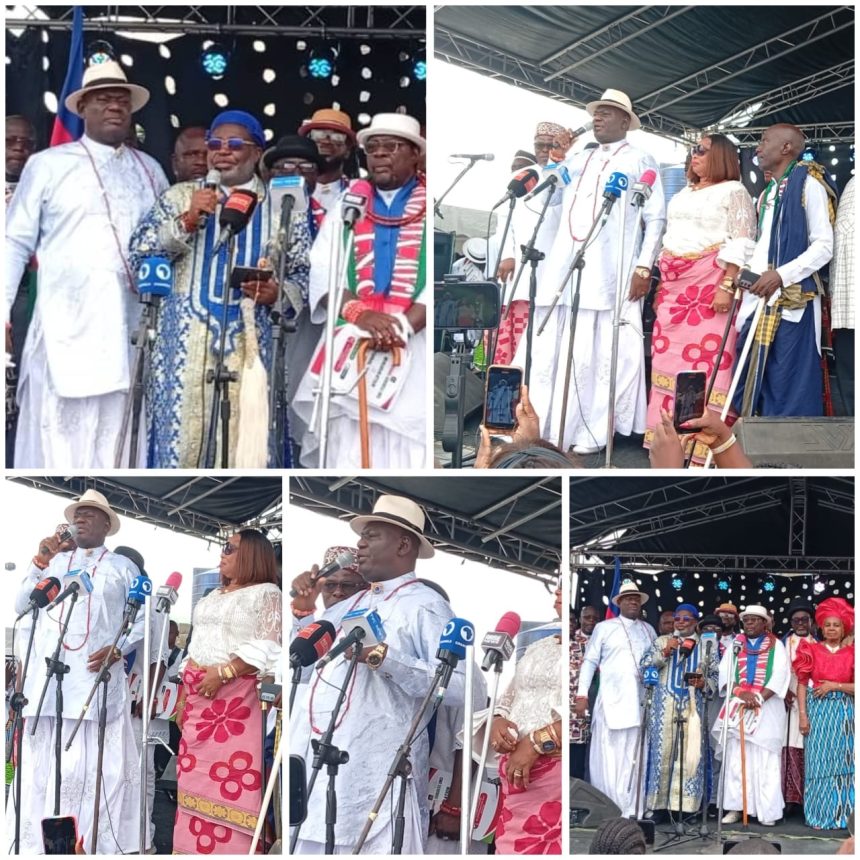
Outgoing President of the Ijaw National Congress (INC), Professor Benjamin Ogele Okaba, has outlined the achievements, challenges and future direction of the organization as he formally handed over leadership after completing a five-year tenure.
Okaba delivered the valedictory address on May 14, 2026, during the inauguration of the new National Executive Council of the INC at Tunde Smooth Playground in Ogbeh Ijo Kingdom, Warri, Delta State. He said the date marked exactly five years since he assumed office as president of the Congress.
Reflecting on the state of the organization when his administration took over in 2021, Okaba said the INC had spent seven years without leadership and had become largely inactive. According to him, the organization faced internal divisions, challenges to its autonomy and difficulty in coordinating advocacy on environmental degradation, marginalization and underdevelopment affecting the Ijaw people and the Niger Delta region.
He stated that his administration focused on repositioning the Congress through what he described as a shift “from militancy to the intellectualization of the struggle.” The former INC president said the administration concentrated on international advocacy, the defense of Ijaw territorial identity and engagement with constitutional and political issues affecting the region.
Among the major achievements listed by Okaba was the structural revitalization of the INC. He said the administration reorganized zonal and clan structures, reactivated the National Representatives Council and registered 15 affiliated groups to strengthen the organization’s voice locally and internationally.
Okaba also highlighted the production of a Pan-Ijaw territorial map, which he described as the first comprehensive map identifying Ijaw territories across Nigeria. He said the initiative was aimed at preserving the identity of the Ijaw ethnic nationality and affirming its territorial and cultural continuity.
On political advocacy, the former INC president said the organization consistently defended the interests of the Ijaw people and the Niger Delta. He noted that the Congress publicly supported Rivers State Governor Siminalayi Fubara during the state’s political crisis and called for justice for former Minister of Petroleum Resources Diezani Allison-Madueke and politician Farah Dagogo.
Okaba further recalled that the INC presented demands for the creation of two additional Ijaw states — Toru-Ebe State and Oil Rivers State — during the South-South zonal public hearing on constitutional review held by the National Assembly in July 2025. He said the Congress also sought the creation of 33 additional local government areas for Bayelsa State.
According to him, the requests were intended to address what he described as the long-standing balkanization of Ijaw communities across several states.
On cultural preservation, Okaba said the Congress partnered with the Association of Ijaws in Academics to produce a publication titled Ijaw Heritage through Centuries: Origin, Culture and Experiences. He added that the 2026 National Convention also considered the establishment of an Ijaw Leadership and Language Development Centre as part of efforts to preserve the language and cultural identity of the Ijaw people.
The outgoing president said the National Convention also approved the recognition of 23 additional Ijaw clans to improve inclusiveness and representation within the Congress. He added that the convention endorsed the inclusion of at least three women, representing different zones, in the INC Board of Trustees.
On international engagement, Okaba described the admission of the Ijaw Nation into the United Nations Unrepresented Peoples Organization (UNPO) in October 2025 as one of the most significant milestones of his administration. He said the membership created opportunities for international advocacy on environmental and humanitarian issues affecting the Niger Delta.
He also referenced the 2022 World Ijaw National Congress in Houston, Texas, where the “Houston Declaration” was adopted. According to him, the declaration formally internationalized the “Ijaw Question,” while the proclamation of July 5 as “Ijaw Day” by the Mayor of Houston increased global recognition for the Ijaw people.
Okaba noted that the INC also expanded its international presence through the inauguration of a West African chapter in Ghana in August 2025, adding to existing chapters in Europe and the Americas.
He congratulated former Bayelsa State Governor Senator Henry Seriake Dickson over the formation of the National Democratic Party (NDC), describing it as a development comparable to the political awakening experienced by the Ijaw people in the 1950s.
Despite the achievements, Okaba acknowledged that the tenure faced several challenges, including oil spills in communities such as Gbaramatu, Nembe and Bille, as well as internal disagreements within the Congress.
He expressed concern over the inability of successive administrations, including his own, to transform the INC into a financially independent organization. He urged the incoming leadership to address what he described as the excessive influence of a few elite interests within the Congress.
The outgoing president praised the electoral committee led by Justice Tabai for conducting what he called a free and credible election despite internal tensions.
Addressing his successor, High Chief Macdonald Igbadiwei, Okaba urged the new leadership to prioritize reconciliation, strengthen international advocacy through the UNPO platform and continue campaigns for the creation of Toru-Ebe and Oil Rivers states.
He also encouraged the incoming administration to deepen policy and research efforts on fiscal federalism and continue defending the Pan-Ijaw territorial identity.
In his concluding remarks, Okaba appealed for forgiveness from those he may have offended during his tenure and thanked supporters and critics alike for their contributions to the growth of the Congress.
He urged members of the Ijaw Nation to continue supporting the INC through active participation, constructive criticism and accountability, while expressing confidence that the new leadership would build on the achievements of the outgoing administration.